

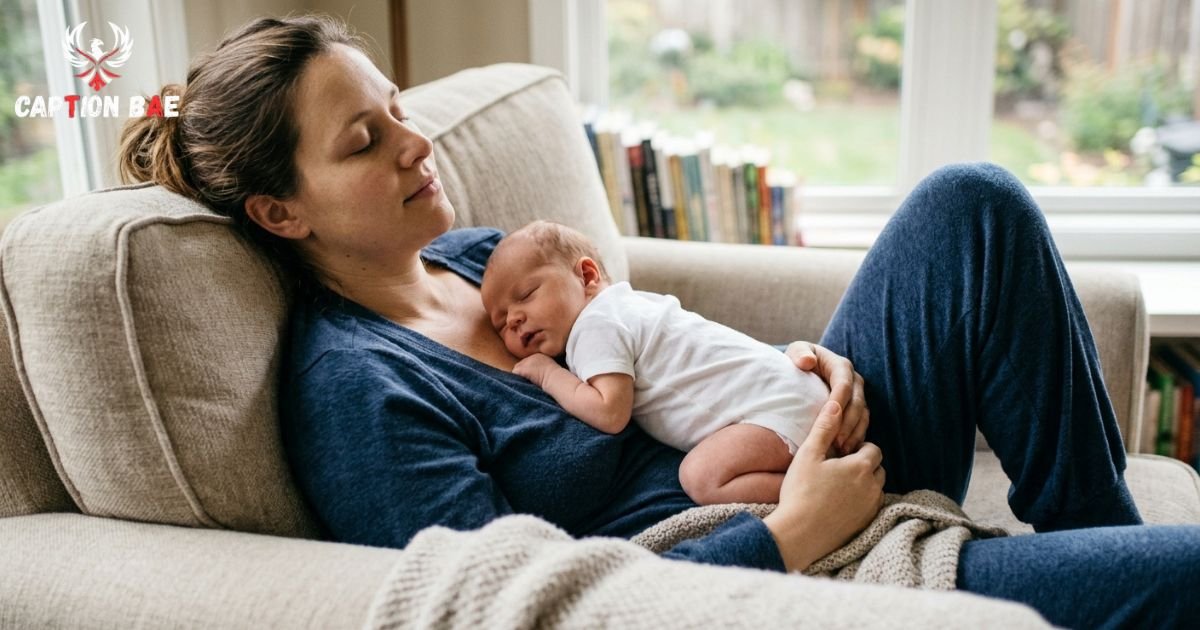
Contact naps happen when your baby sleeps while being held in your arms, usually against your chest. While some parents worry that contact naps create bad habits, they are a normal part of infant sleep and can provide important comfort and closeness. Research on infant development suggests that responsive physical contact can support emotional regulation and the parent-baby attachment bond. In this guide, we’ll explore the science behind contact napping, its potential benefits, how it affects your baby’s development, and when babies typically begin sleeping more independently.
What Is Contact Napping? (And How It Differs)
Contact napping is intuitive and ancient. It’s when your little one sleeps in your arms, nestled against your chest or cradled in your embrace. Your baby feels your heartbeat, hears your breathing, and absorbs your warmth—all the sensations they experienced in the womb for nine months.
This is not the same as co-sleeping, where you and your baby share a sleep surface (sometimes both asleep). Contact napping requires you to stay awake and alert, maintaining direct physical connection. It’s also different from babywearing for naps, though babywearing can be a hands-free alternative to holding.
For decades, parents have naturally held their babies to sleep. Yet today’s culture sends mixed messages: embrace your baby, but also worry you’re creating dependency. Making matters worse, societal expectations tell mothers they should be “productive” during every free moment—which makes holding a sleeping baby feel, somehow, like wasted time.
Read More: Monthly Baby Photos Instagram Captions That Melt Hearts
Why Contact Naps Matter: The Fourth Trimester Foundation
The Fourth Trimester Explained
Your newborn just spent nine months in a dark, warm, snug environment. Suddenly, they’re outside the womb—flooded with light, temperature changes, and endless stimulation. This jarring transition is called the fourth trimester: roughly the first three months of life, when babies are still neurologically “finishing” their development outside the womb.
Pediatrician Harvey Karp popularized this concept over 20 years ago, and it fundamentally reframes how we think about newborn behavior. Babies aren’t being difficult; they’re doing exactly what they’re wired to do—seek closeness, security, and the rhythmic sensations of their previous environment.
Contact naps are one of the most powerful ways to provide this bridge. When your baby sleeps on your chest, they’re not being spoiled. They’re getting exactly what their developing nervous system needs.
Physiological Regulation: The Role of Parental Contact
Here’s what’s happening when your baby is pressed against you:
Your infant’s heart rate, breathing rate, and body temperature stabilize through proximity to you. This isn’t poetic—it’s physiological. Babies born prematurely in neonatal intensive care units benefit enormously from “kangaroo care” (skin-to-skin contact), which the American Academy of Pediatrics (AAP) recognizes as reducing stress and improving sleep quality.
Your baby also receives rich sensory input: the smell of your skin, the sound of your heartbeat and breath, the rhythm of your movements. These inputs trigger the formation of neural pathways in your baby’s brain. Every time you hold your baby during sleep, you’re literally building their brain architecture.
Seven Science-Backed Benefits of Contact Naps for Babies
1. Brain Development & Neural Pathway Formation
Sleep is when babies’ brains do their heavy lifting. During naps, the brain consolidates learning, organizes sensory information, and builds connections between neurons. When your baby sleeps on contact, they’re not just resting—their brain is constructing the neural highways they’ll use for life.
The sensory richness of contact—touch, sound, smell, warmth—provides the input necessary for healthy brain maturation. Newborns spend up to 75 percent of their sleep time in active sleep (REM), where dreaming and memory consolidation happen. Contact during this stage matters.
2. Stress Hormone Regulation (Cortisol Reduction)
Babies are born with immature nervous systems. They can’t regulate their own stress response yet; they rely on you to help them do it. When your baby is in your arms, their cortisol (stress hormone) levels drop measurably. This isn’t anecdotal—research on skin-to-skin contact consistently shows this effect.
Lower stress hormones mean better sleep quality, improved digestion, and a calmer nervous system overall. Over time, this teaches your baby’s body how to self-regulate, which pays dividends for decades.
3. Enhanced REM & Deep Sleep
Babies cycle through sleep stages rapidly—much faster than adults. They also need a lot of REM sleep, where most of their brain development happens. When your baby is in contact, they often fall back to sleep more easily during these micro-arousals (the natural brief wakings between sleep cycles).
Here’s the magic: if your baby wakes slightly and feels your presence, hears your heartbeat, and experiences your gentle movements, they often slip back into sleep without fully waking. Alone in a crib, they must learn to self-soothe through these transitions—a skill that takes time to develop.
4. Secure Attachment & Lifelong Emotional Outcomes
Attachment theory, rooted in decades of developmental psychology research, shows that babies who experience responsive, consistent care develop secure attachment to their caregivers. And here’s the counterintuitive part: secure attachment leads to greater independence later in life, not dependency.
Children with secure attachments show:
- Greater confidence and curiosity
- Better emotional regulation in adolescence and adulthood
- Lower rates of anxiety and depression
- Stronger social skills and relationships
Contact napping—responding to your baby’s need for sleep and comfort—is a cornerstone of this secure attachment. You’re not creating a clingy baby; you’re building a confident one.
5. Bonding & Oxytocin Release (The “Love Hormone”)
When you hold your sleeping baby, your body releases oxytocin—a hormone associated with bonding, trust, and calm. Your baby experiences this same hormonal shift. This is a bilateral gift: you’re both being soothed and bonded simultaneously.
Oxytocin also reduces maternal stress and anxiety, which is why many parents report feeling more grounded and peaceful during contact naps (even if they’re also frustrated about the mess).
6. Successful Feeding & Lactation Support
For breastfeeding families, contact naps offer real practical benefits. When your baby naps in your arms, you’re immediately available to respond to hunger cues. Many breastfeeding mothers find that contact naps support more responsive feeding patterns and smoother lactation.
The AAP and International Lactation Consultant Association (ILCA) recognize skin-to-skin contact as supporting breastfeeding success. Contact naps extend this benefit.
7. Longer, More Restorative Naps (In Some Babies)
Not all babies sleep longer on contact—some nap 30–45 minutes either way. But many parents report that their babies sleep longer and more deeply when held. Why? The familiar comfort allows them to relax more completely, cycling through full sleep stages without the micro-arousals that interrupt crib sleep.
Longer naps mean your baby gets better-consolidated sleep, which supports growth, brain development, and daytime alertness.
Read More: Monthly Milestone Captions for Every Baby Growth Moment
Contact Napping Benefits for Parents: The Under-Covered Story
The conversation around contact naps usually centers on the baby. But you matter too. Here’s what science says about parental benefits:
Stress Reduction & Maternal Mental Health
Holding your baby releases the same oxytocin that benefits your baby—and it directly reduces your stress and anxiety. Research shows that consistent skin-to-skin contact is associated with lower cortisol levels in caregivers and reduced symptoms of postpartum anxiety and depression.
The AAP recognizes that responsive care, including holding babies for comfort and sleep, is protective for maternal mental health. You’re not being self-indulgent when you enjoy a contact nap; you’re taking legitimate mental health medicine.
Deepened Bonding & Responsive Parenting
Contact naps are a laboratory for learning your baby’s language. You learn their sleep cues, their breathing patterns, and how they signal discomfort. This intimate knowledge builds your confidence in parental responsiveness and intuition.
Parents who practice contact napping often report feeling more confident in their parenting, not less—because they know their baby so well.
The Hidden Productivity: Why “Doing Nothing” Matters
Our culture tells you that nap time is an opportunity to “get things done.” Clean the kitchen. Check emails. Fold laundry. Fit in a workout.
But here’s the reframe: holding your baby while they sleep is productive. You’re building your child’s brain architecture, regulating their nervous system, and creating the foundation for secure attachment. Neuroscience research on child development shows that parental presence and responsiveness in infancy predict better outcomes across emotional, cognitive, and social development.
The laundry will still be there in three months. Your baby’s infancy won’t.
Is Contact Napping Safe? Safety Guidelines & Reassurance
Yes, contact napping is safe—when done correctly. Let’s be clear on the guidelines.
The Golden Rule: Caregiver Must Stay Awake
This is non-negotiable. According to a 2019 study in Pediatrics, between 36 and 66 percent of in-hospital neonatal falls involved caregivers who had nodded off. The Lullaby Trust (UK) reports that over 40 percent of parents have fallen asleep on a sofa or glider while holding their baby.
The risk isn’t the baby falling on you; it’s the baby slipping into an unsafe position, their airway becoming compromised, or them falling if you’re on elevated furniture. If you feel yourself drifting, move your baby to a safe sleep surface immediately.
Safe Contact Nap Positions
Chest-to-chest (upright): Your baby’s head is supported against your chest, their face visible, chin off your chest. Your arm securely cradles them. This is the safest position.
Cradle hold: Baby nestled in your arm, head supported in the crook of your elbow, face visible, airway clear.
What to avoid: Lying down with your baby (risk of rolling, compression, or co-sleeping hazards). Soft surfaces like couches or armchairs where your baby could slip into a gap or get trapped.
Babywearing as a Safe Alternative
If you need hands-free contact naps—to care for other children, move around your home, or simply maintain sanity—babywearing can meet your baby’s contact needs while keeping your hands free.
Critical requirement: Proper positioning. Your baby’s face must always be visible and kissable-close to you (close enough to kiss their forehead without reaching). Their chin should be off their chest, and their airway completely clear. Use a carrier with good reviews and follow the manufacturer’s positioning guidelines.
Read More:Caption for Parents Love Heartfelt Instagram Captions Guide
The “Spoiling Baby” Myth: What Research Actually Says
Can You Create Dependency?
No. This is perhaps the single most important thing to understand about responsive parenting.
Developmental psychologists have known for decades (since Bowlby’s attachment research in the 1950s) that responsive care does not create dependency; it creates security. Babies whose needs are consistently met develop secure attachment, which paradoxically leads to greater independence later.
Think about it: a child who knows their needs will be met develops confidence. A child who has learned to self-soothe with a caregiver’s support becomes more capable of self-soothing independently. Security is the foundation for independence.
Yes, your baby may develop a sleep association with contact—a preference for falling asleep in your arms. All humans (even adults) have sleep associations. The issue isn’t whether your baby has one; it’s whether they’re flexible enough to sleep in more than one way.
Sleep Associations vs. Dependency
Here’s a practical truth: A baby who naps on contact AND can nap in a crib is actually more flexible than a baby who only naps in a crib and panics if held.
Sleep associations are normal. Dependency—an inability to function without one specific sleep method—is rare and typically occurs only when a baby has never been exposed to alternative sleep settings or has experienced trauma.
Your baby is not being damaged by contact naps. They’re being held by their parents during sleep. That’s not a problem to fix; it’s a phase to enjoy.
When Babies Naturally Transition: Developmental Milestones by Age
0–3 Months (Fourth Trimester): Contact Naps Are Developmentally Necessary
During the fourth trimester, your baby’s central nervous system is still maturing. They haven’t yet developed the ability to self-soothe, regulate their temperature independently, or understand that you’ll come back after you leave.
What’s happening: Rapid brain development, sensory system maturation, and circadian rhythm establishment.
What parents should do: Embrace contact naps guilt-free. This is not the time to prioritize independence training. Your baby needs contact to develop properly. Hold them without apology.
4–6 Months: Introduction to Independent Naps (Optional)
Around 4–6 months, developmental changes make some babies more amenable to crib napping:
- Object permanence begins developing (baby understands that you still exist when out of sight)
- Self-soothing reflexes emerge (hand-to-mouth, finding pacifiers)
- Awareness of surroundings increases (baby notices the crib, the ceiling fan, light)
What’s happening: Brain maturation enabling slightly more independence.
What parents should do: No rush. Many babies this age still strongly prefer contact. If you want to introduce crib naps, try one nap per day. But many thriving 5-month-olds still primarily contact napping, and that’s completely normal.
6–9 Months: Natural Decline in Contact Nap Preference
Many (not all) babies in this age range naturally start resisting contact naps. Why? Increased FOMO (fear of missing out). Your baby is more aware, more interested in toys and activities, and increasingly independent.
Signs of readiness: Fidgeting during contact naps, shorter nap durations, waking frequently mid-nap, falling asleep in strollers or swings without complaint.
What’s happening: Brain development creates new interests and independence drives.
What parents should do: Gently encourage crib naps if your baby shows signs of readiness. But occasional contact naps are still normal and beneficial at this age.
9–12+ Months: Most Babies Can Nap Independently
By 9–12 months, most babies can nap independently, though not all prefer to. Separation anxiety often peaks around 9 months, then gradually subsides.
What’s happening: Increasing independence, stronger self-soothing skills, and shifting sleep needs.
What parents should do: Most babies transition to primarily crib naps by this age, though some still prefer contact. There’s no deadline. Every baby has their own timeline.
Read More: Controlling Parents 22 Signs, Long Term Effects & How to Reclaim Your Life
Gentle Transition Tips (If & When You’re Ready)
Transition is a word that matters here. You’re not training your baby to stop needing comfort; you’re supporting their natural developmental progression toward independent sleep. This takes patience, consistency, and self-compassion.
1. Start with Just One Nap
Pick one nap per day—ideally the first morning nap, when sleep pressure is highest and your baby is most likely to succeed.
Keep all other naps as contact naps (for now). This gives your baby predictability and you a lower-stakes place to practice. One success breeds confidence.
2. White Noise & Routine Cues
Use white noise during contact naps, then continue it during crib naps. Familiar sounds signal sleep time and help your baby recognize the transition. White noise mimics the womb’s constant background sound, which naturally soothes babies.
Create a short pre-nap routine: dim the lights, turn on white noise, read a brief story or sing a song. The routine telegraphs “sleep time” to your baby’s developing brain.
3. The “Drowsy But Awake” Placement
Place your baby in their crib when sleepy but not yet fully asleep. This gives them the opportunity to practice falling asleep without you.
This sounds harder than it is. Your baby will probably fuss a bit—that’s normal. They’re learning a new skill. Stay nearby, use a calm voice, and offer reassurance without immediately picking them back up. Many babies fall asleep within 5–10 minutes.
4. The Transfer Technique (For Babies Already Asleep)
If your baby falls asleep in your arms, wait 15–20 minutes until they’re in deep sleep (their body will feel heavier and more relaxed). Then slowly, gently transfer them to their crib, keeping them close to your body until the final moment.
Once in the crib, rest your hand on their chest for a moment—continued contact helps them stay calm. Gradually reduce hand contact as they build confidence over days and weeks.
5. Flex Your Approach
Here’s the secret: flexibility beats rigidity. If your baby gets sick, is teething, going through a developmental leap, or traveling, they may desperately need contact naps again. That’s not regression; that’s responsive parenting.
Return to contact naps without guilt. Your baby will transition back to crib naps once things settle down. You’re not undoing progress; you’re meeting their current needs.
6. Use Comfort Objects
A sleep sack, a lightweight blanket (safe for their age), or a lovey can provide some of the comfort your baby experiences with you. It’s not a replacement for your presence—it’s a supplement.
Some babies become attached to a lovey and use it as a self-soothing tool; others ignore it entirely. Both are fine. Don’t force it.
Conclusion
Contact napping is a natural and comforting part of early infancy that can support bonding, emotional security, and restful sleep. While every baby develops differently, there is no need to feel guilty if your little one prefers sleeping close to you. As babies grow and become more independent, their sleep habits often change naturally. The key is to enjoy these quiet moments while also following safe-sleep practices and gradually encouraging healthy sleep habits when your baby is ready.
FAQs
Do babies outgrow contact naps naturally?
Yes. Most babies show decreasing interest in contact naps between 4 and 8 months, as their development naturally pushes them toward independence. Some babies continue enjoying occasional contact naps well into toddlerhood. The timeline varies widely, but all babies eventually sleep independently. This isn’t something you need to force; it happens naturally with gentle support.
Can contact naps spoil a baby or create lasting dependency?
No. Research on attachment shows that responsive care—holding your baby when they need it—actually builds secure attachment and increases independence later. Babies whose needs are consistently met develop confidence, not clinginess. All babies eventually learn to sleep independently, regardless of contact napping.
Is it safe to nap on a couch or bed?
Not recommended. Couches and beds have gaps, soft edges, and pillows where a baby can slip into an unsafe position or become trapped. Contact naps are safest upright in a chair or on a firm surface where your baby’s airway remains clear and you maintain full control.
What’s the difference between contact naps and co-sleeping?
Contact napping: you’re awake, baby sleeps on you or in your arms, you maintain active supervision. Co-sleeping: you and baby share a sleep surface, often both asleep. Contact napping is inherently more supervised; co-sleeping carries different safety considerations. They’re distinct practices.
My 8-month-old still prefers contact naps. Is this a problem?
No. Every baby has their own timeline. Some babies naturally transition to independent naps by 6 months; others take until 12+ months or beyond. If your baby is happy, growing well, and developing normally, there’s no problem. Continue offering opportunities for crib naps, but honor your baby’s current needs.
Can babywearing replace contact naps?
Yes, safely done. Babywearing provides contact while freeing your hands. Ensure your baby’s airway is always clear, their face is visible, and you follow the carrier’s positioning guidelines. Babywearing is a practical alternative when you need hands-free contact naps.
My family is criticizing my contact napping. What should I say?
You can share that responsive parenting is supported by pediatric research. The American Academy of Pediatrics and developmental psychologists recognize that holding babies for sleep and comfort supports healthy attachment and development. Politely: “My pediatrician supports this approach, and research shows it’s beneficial for my baby’s development.”
