


No. A 7-month-old can’t be reliably diagnosed with autism. Some babies later diagnosed show early differences in smiling, eye contact, and sounds, but these are clues, not proof. By age 2, an experienced professional can make a reliable diagnosis, though many children are diagnosed later. Concerns are worth sharing now.
Can You Tell If a 7-Month-Old Has Autism?
Autism spectrum disorder (ASD) is a developmental condition that affects how a person communicates, interacts, and behaves. Doctors diagnose it by looking at a child’s development and behavior, not with a blood test or scan.
The honest answer at 7 months is no, not yet. The CDC says autism can sometimes be detected at 18 months or younger, and that by age 2 a diagnosis from an experienced professional can be considered reliable. It also notes that many children don’t get a final diagnosis until much later.
Why the wait? Autism looks different in every child. Autism Speaks notes that some children show early signs in their first 12 months, while in others the signs don’t appear until 24 months or later. Autism SA, a leading autism organization in Australia, says it can be hard to recognize until about 18 to 22 months.
So at 7 months, you’re not looking for proof. You’re looking for patterns worth mentioning.
What Most Babies Are Doing at 6 and 9 Months (CDC Milestones)
Here’s something most guides skip: the CDC has no 7-month checklist. It publishes checklists at 2, 4, 6, 9, and 12 months, and so on.
The CDC’s rule is simple: if your child’s age falls between two checklists, use the younger one. For a For a 7-month-old, that means the 6-month listthat means the 6-month list. The 9-month list shows what’s coming next.
How to read the “75% rule”
CDC milestones are things 75% or more of children can do by that age. That means a baby who hasn’t hit one yet isn’t automatically behind. Up to about 1 in 4 typical babies may not be there yet.
The CDC’s advice if you’re unsure: watch for a week or two, give your baby chances to show the skill, and if you still don’t see it, talk to your child’s doctor.
| Area | By 6 months (use this now) | By 9 months (coming up) |
| Social and emotional | Knows familiar people; likes looking in a mirror; laughs | Shy, clingy, or fearful around strangers; shows several facial expressions; looks when you call their name; reacts when you leave; smiles or laughs at peekaboo |
| Language and communication | Takes turns making sounds with you; blows raspberries; makes squealing noises | Makes lots of different sounds like “mamama” and “bababababa”; lifts arms up to be picked up |
| Thinking and learning | Puts things in mouth to explore; reaches for a toy they want; closes lips to show they don’t want more food | Looks for objects dropped out of sight; bangs two things together |
| Movement | Rolls tummy to back; pushes up with straight arms on tummy; leans on hands when sitting | Gets to sitting by themselves; moves things hand to hand; rakes food toward themselves; sits without support |
Born early? Use corrected age
If your baby was born more than 3 weeks early, the CDC says to use their corrected age, not their birthday age. A baby born 8 weeks early who is 7 months old by the calendar would be compared with the checklist for about 5 months. Ask your pediatrician to confirm the right checklist.
Read More: 7 Month Old Meal Ideas: Safe Foods, Portions & 7-Day Plan
Early Signs of Autism at 7 Months
These are the early signs researchers and clinicians describe in babies later diagnosed with autism. Many typical babies show a few of them sometimes. UC San Diego’s autism center says it is very common for typically developing children to show some early red flags too. What matters is a pattern that continues over weeks, across more than one area.
Social signs
- Rarely smiles when you approach or play with them
- Few warm, joyful expressions, or little eye contact (Autism Speaks lists this by 6 months)
- Seeks your attention rarely
- Doesn’t reach up toward you when you reach to pick them up
- Little shared fun in games like peekaboo
A caution on eye contact: UC San Diego notes that some children with autism have appropriate eye contact. So eye contact alone can’t tell you much.
Communication signs
- Little or no back-and-forth sounds with you (the CDC’s 6-month list includes taking turns making sounds)
- Delayed or infrequent babbling. Strings like “mamama” are a 9-month milestone, so look at the overall pattern of sounds, not that one skill
- Rarely copies sounds or movements, such as smiles and laughs, during simple play
- Doesn’t respond to their name more often as months pass. Kennedy Krieger’s autism specialist Dr. Rebecca Landa lists this as a sign to watch across 6 to 12 months
Movement, play, and sensory signs
- Repeatedly stiffens arms, hands, or legs, or does unusual repeated movements such as rotating the hands at the wrists
- Delays in rolling, pushing up, or crawling
- Unusual reactions to sound, such as little reaction to loud sounds or strong upset at ordinary ones (Autism SA)
Looking ahead, Dr. Landa also lists no gestures to communicate by 10 months. That’s a good one to keep in mind after your baby’s next birthday month.
Normal Baby Behaviors That Can Look Like Autism
Babies do odd-looking things on the way to typical development. Here’s how to tell the difference.
| What you see | Why it’s often normal | When to look closer |
| Putting everything in their mouth | Exploring with the mouth is a CDC 6-month milestone | If they show little interest in reaching for toys at all |
| Banging or repeating an action | Banging two things together is a CDC 9-month milestone | If you often see unusual repeated body movements, like stiffening or hand-rotating |
| Not saying “mamama” yet | Strings of sounds are a 9-month milestone | If there are few sounds and little back-and-forth turn-taking |
| Not sitting alone | Leaning on hands to sit is the 6-month milestone; sitting without support is 9 months | If rolling and pushing up are also delayed |
| Not reacting to strangers yet | Wariness of strangers is a 9-month milestone, so it may still be developing | If several social items are missing together |
| Not looking when called | Looking at their name is a 9-month milestone | If it stays that way after a week or two of trying, or you also doubt their hearing |
The pattern is the clue. One missing item is rarely meaningful by itself.
What If My 7-Month-Old Doesn’t Respond to Their Name?
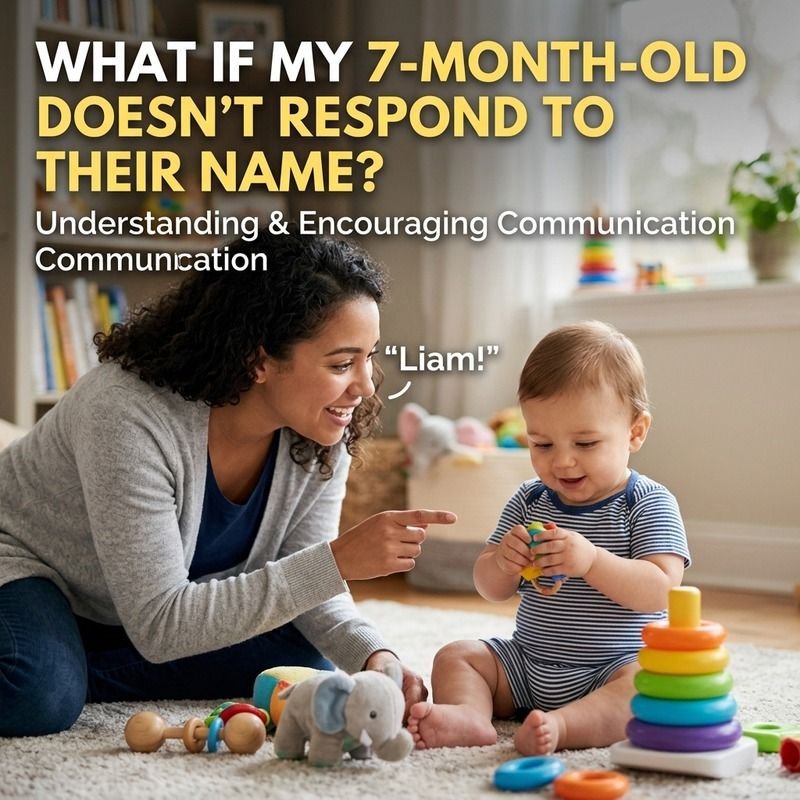
Looking when you call their name is a CDC 9-month milestone, so many 7-month-olds are still learning it. Try again in different rooms and tones for a week or two. If there’s still no response, mention it to your pediatrician and ask about a hearing check, because hearing loss can look like ignoring.
Could it be hearing?
Yes, and it’s worth ruling out first. The New York State Department of Health notes that hearing can change at any time, so a baby can pass the newborn hearing screening and still have hearing loss later. Emory University’s pediatrics division lists an older infant who doesn’t respond to their name or to sounds among the reasons to ask about a hearing test with a pediatric audiologist.
This matters for two reasons. Hearing loss is very treatable when found early. And fixing a hearing problem is a very different path than an autism evaluation.
Read More: 8 Months Old Baby Caption: 150+ Cute, Funny & Sweet Ideas
Does Having an Autistic Sibling Change the Odds?
Yes. Researchers from UC Davis MIND Institute and the Baby Siblings Research Consortium report:
- About 20% (20.2%) of younger siblings of autistic children are later diagnosed with autism, roughly seven times the rate in children with no autistic sibling.
- 25% for baby boys, versus 13% for baby girls, in the same study.
- 37% when a baby has more than one autistic sibling, versus 21% with one.
That also means about 4 in 5 baby siblings are not diagnosed. Think of family history as a reason to look a little more closely and ask for screening, not as a prediction. Tell your pediatrician about it early.
What Should You Do If You’re Worried?
- Check the right CDC checklist. Use the 6-month list now (corrected age if your baby came early). The CDC’s free Milestone Tracker app has the checklists with reminders.
- Give your baby a chance to show the skill. Play peekaboo. Call their name from the side. Trade sounds back and forth. Do this for a week or two.
- Write it down and take a short video. Note what you saw, when, and how often. A 30-second clip of the behavior is far more useful to a doctor than a description.
- Talk to your pediatrician. Share what you’ve noticed, then ask for three things: a developmental screening, a hearing check, and, if concerns remain, a referral to a specialist. The CDC says to ask to be connected with a specialist and with supports and services if you’re still concerned after screening.
- Contact your state’s Early Intervention program. Under Part C of IDEA, parents can ask for a free evaluation for children from birth to age 3. ZERO TO THREE says families don’t need a diagnosis or doctor’s approval to ask. Each state sets its own eligibility rules.
- Don’t “wait and see.” Dr. Landa urges parents who suspect delays, or see lost skills, to talk with a pediatrician or developmental expert rather than waiting. If you feel brushed off, ask again or get a second opinion.
A simple script you can use: “Over the last [number] weeks I’ve noticed [what you saw]. Can we do a developmental screening and check her hearing? Is a referral to a specialist or Early Intervention a good idea?”
One important note: CDC milestone checklists and tools like these are not a substitute for validated developmental screening done by professionals.
Read More: 5 Month Old Baby Captions: 100+ Cute, Sweet & Loving Instagram Ideas
When Are Babies Screened and Diagnosed?
The American Academy of Pediatrics (AAP) recommends this schedule at regular well-child visits:
| Age | What the AAP recommends |
| 9 months | Developmental and behavioral screening |
| 18 months | Developmental and behavioral screening plus autism-specific screening |
| 24 months | Autism-specific screening |
| 30 months | Developmental and behavioral screening |
A common autism questionnaire, the M-CHAT-R/F, is designed for children 16 to 30 months old. So you won’t see it at 7 months. A screening only shows whether a closer look is needed. It does not diagnose.
The CDC also says parents are reliable sources of information about their child’s development. Your observations count.
How common is autism?
The CDC’s 2025 report, based on 2022 data from 16 U.S. sites, found about 1 in 31 8-year-olds identified with autism.
Can Signs Appear Later, or Skills Be Lost?
Yes. Dr. Landa cautions that some children who go on to be diagnosed don’t show signs until after their second birthday, and some lose skills after seeming to develop typically.
If your baby stops doing something they used to do, such as babbling, smiling, or responding to you, don’t wait for the next scheduled visit. Call your pediatrician.
Read More: 7-Month-Old Baby Killed in Brooklyn What We Know
What Research Can See vs. What You Can See
In lab studies, scientists use eye-tracking to measure where babies look. One widely cited study, listed in UC San Diego’s references, reported that attention to eyes declined between 2 and 6 months in infants later diagnosed with autism.
That’s measured with special equipment. You can’t see it at home, and it’s not a test. It does explain why researchers say differences can begin early, and why parents shouldn’t expect one dramatic sign.
Also, Dr. Landa’s research with infant siblings suggests diagnosis is possible in some children as young as 14 months. That’s why the first-year observations in this guide matter, even though they can’t diagnose.
A Note for Worried Parents
Watching your baby this closely isn’t overreacting. It’s paying attention. Most babies who skip a milestone for a few weeks turn out to be developing typically. And if there is something to find, earlier support means more time to help.
Conclusion
At 7 months, you can’t diagnose autism, but you can watch the pattern. Use the CDC’s 6-month checklist, preview the 9-month one, and rule out hearing. Keep notes and a short video. Talk to your pediatrician about developmental screening, and call Early Intervention if you’re worried. You don’t need a diagnosis to ask.
FAQs
Can a 7-month-old be diagnosed with autism?
No. Doctors can’t reliably diagnose autism at 7 months. Early signs can show up, but a reliable diagnosis from an experienced professional is generally possible by about age 2.
What are the earliest signs of autism?
Early signs can include few warm smiles, little eye contact, little back-and-forth babbling, and not responding more often to their name. They can also include unusual repeated body movements. No single sign is proof, so look for patterns.
Is it normal if my 7-month-old isn’t babbling yet?
Often, yes. “Mamama”-style sounds are a CDC 9-month milestone. At 6 months, look for squeals, raspberries, and taking turns making sounds with you. If you’re not seeing those, mention it to your pediatrician.
What’s the earliest age autism can be diagnosed?
The CDC says autism can sometimes be detected at 18 months or younger, and by age 2 a diagnosis is considered reliable. Dr. Landa’s research suggests some children can be diagnosed as young as 14 months.
When is a baby screened for autism?
The AAP recommends autism-specific screening at 18 and 24 months, plus general developmental screening at 9, 18, and 30 months. If you have concerns sooner, you can raise them at any visit.
Do autistic babies make eye contact?
Some do. UC San Diego notes that some children with autism have appropriate eye contact, so it isn’t a reliable test by itself. It matters more alongside smiling, sounds, and back-and-forth play.
Does a sibling with autism raise the chance?
Yes. About 20% of younger siblings of autistic children are later diagnosed, according to UC Davis and the Baby Siblings Research Consortium. Tell your pediatrician about family history early.
