

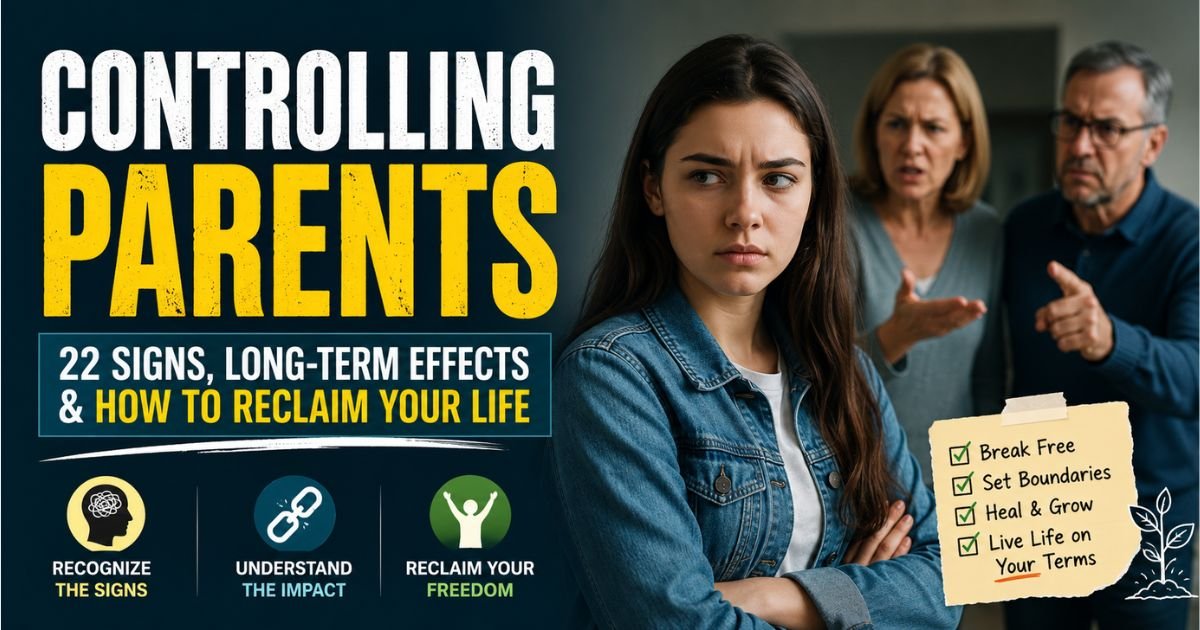
Controlling parenting is a harsh parenting style in which one or both parents keep close tabs on their child’s life, enforce strict rules with little flexibility, and prioritize obedience over independence. The effects ripple into adulthood affecting your confidence, relationships, and mental health. But recovery is possible. Boundary-setting, self-understanding, and often therapy can help you break the pattern and reclaim autonomy over your own life.
What Is Controlling Parenting? (And How It’s Different From Healthy Structure)
Before we go further, let’s make a critical distinction: being a parent “in charge” is healthy. Being “in control” is not.
Being “in charge” means you set the framework. You establish routines, expectations, and boundaries. You manage your child’s environment. But within that framework, your child has room to grow, make mistakes, and develop their own voice. You listen. You collaborate. You explain why rules exist.
Being “in control” means you dictate every decision. You enforce rules with little negotiation. You expect obedience without question. You may withdraw love when your child doesn’t comply. You’re focused on your needs and your vision for who your child should be—not on who they actually are.
Controlling parenting is also called authoritarian parenting. It sits at one end of the parenting spectrum, opposite permissive (too loose) and distinct from authoritative (healthy structure + warmth + autonomy).
Why does this matter? Because if you’re a parent yourself, understanding this difference can change everything. You can set boundaries without crushing independence. You can be firm without being controlling.
The Psychology Behind It Why Parents Become Controlling
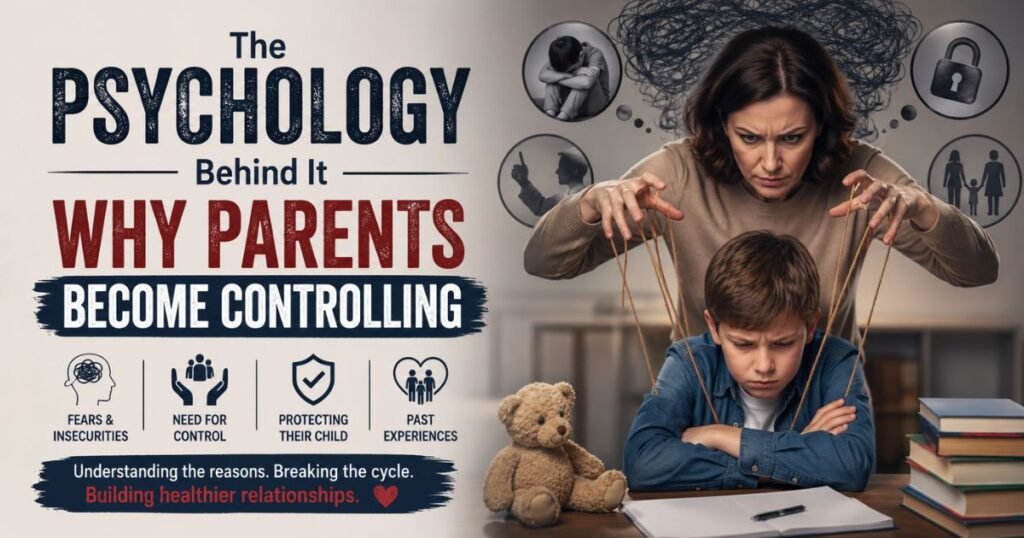
Here’s what’s rarely discussed: controlling parents aren’t usually malicious. They’re usually anxious.
Research shows controlling behavior stems from a parent’s own stress, fear, or past experiences—not from a child’s defiance. Understanding why can shift how you see your own parents, and how you parent if you have kids.
Common Root Causes:
1. Parental Anxiety
Parents who are naturally anxious or fearful often try to control outcomes to manage their worry. “If I control everything, nothing bad will happen.” This rarely works, but the impulse is powerful.
2. Modeling From Their Own Childhood
Your parents might have been raised this way. They’re repeating what they learned. Breaking generational patterns takes awareness and work.
3. Life Stress (Financial, Relational, Neighborhood Danger)
A parent going through a divorce, financial crisis, or living in an unsafe neighborhood may become more controlling as a coping mechanism. Stress narrows focus and reduces empathy.
4. Perfectionism & High Achievement
Some controlling parents have internalized a message that only perfection is acceptable. They push their children hard because they believe it’s the path to success—and safety.
5. Insecure or Anxious Attachment Style
Parents with anxious attachment often fear abandonment or loss of control. They over-involve themselves in their child’s life to feel secure.
6. Cultural or Generational Norms
In some cultures and generations, authoritarian parenting was (and is) seen as the right way. Control = responsibility. Discipline = love. These norms persist.
7. Their Own Unresolved Trauma
A parent who experienced chaos, abuse, or unpredictability in childhood may overcorrect by controlling everything. They’re trying to create the safety they never had.
The key insight: Recognizing these roots doesn’t excuse controlling behavior. But it can help you depersonalize it. Your parent’s control is about them, not a reflection of your worth.
22 Signs of Controlling Parents
How do you know if you had (or have) a controlling parent? Here are 22 signs, organized by category.
Behavioral Control & Rules:
- Using harsh punishment or coercive discipline. Your parents enforced rules with punishments that felt disproportionate—yelling, shaming, physical punishment, or threats that scared you.
- Demanding blind obedience. “Because I said so” was the only explanation you got. Questions were shut down. Your opinion didn’t matter.
- Imposing excessive rules and changing them arbitrarily. Rules felt random and constantly shifting, keeping you on edge and uncertain.
- Over-monitoring and surveillance. Your parents tracked your location, read your texts, checked your social media, or went through your room regularly.
- Eliminating or allowing little privacy. You had no space that felt truly yours. Your parents expected full transparency into your life.
- Managing your responsibilities. Your parents took over tasks (laundry, scheduling, paying bills) or micromanaged how you did them, preventing you from learning independence.
Emotional Manipulation & Conditional Love:
- Offering love conditionally. Affection and approval were tied to performance—grades, achievements, obedience. Love felt like a reward, not a birthright.
- Using guilt-tripping to manipulate. “After everything I’ve done for you…” or “You’re making me so sad/angry/disappointed” were weapons.
- Threatening withdrawal of support. Your parents threatened to kick you out, cut off financial help, or refuse emotional support if you didn’t comply.
- Gaslighting and invalidating your feelings. Your parents denied events happened, told you you’re too sensitive, or insisted your emotions were wrong. “You’re overreacting.”
- Showing a lack of empathy and respect. Your parents dismissed your emotions, interests, and experiences without trying to understand.
- Giving negative criticism instead of positive feedback. You rarely heard praise. Criticism was constant. Nothing you did was ever quite good enough.
Invasion of Autonomy & Identity:
- Discouraging independence. Your parents actively prevented you from developing skills or gaining experiences (driving, getting a job, making decisions).
- Interfering in all aspects of your life. Your parents tried to control academic choices, career path, friend groups, romantic relationships, and major life decisions.
- Over-involving themselves in social relationships. Your parents dictated who you could befriend, monitored your relationships, or created tension with your friends.
- Criticizing your appearance and personal choices. Your parents frequently commented on what you wore, how you styled your hair, or other personal decisions.
- Failing to appreciate your individuality. There was little space for you to form your own beliefs, develop your own style, or pursue your own interests. You were expected to be a mini version of your parents.
- Setting unattainable or perfectionist standards. Your parents set unrealistically high expectations and punished you for not meeting them.
- Insisting on being always right. Your parents couldn’t tolerate disagreement. Different opinions were seen as disrespect or defiance.
Financial & Relationship Control:
- Controlling you through financial rewards. Your parents used money as leverage—giving gifts or bailing you out, then holding it over your head or expecting repayment in compliance.
- Creating unhealthy dependency. Your parents actively discouraged you from becoming self-sufficient, making you reliant on them for validation, money, or decision-making.
- Insisting on being involved in your adult life. Even as a grown adult, your parents continue to meddle, criticize, or expect you to prioritize them.
Long-Term Effects on Adult Children
Controlling parenting doesn’t end when you turn 18. The effects ripple through decades, shaping how you see yourself, make decisions, and relate to others.
Here’s what the research shows:
On Self-Esteem & Identity
When a parent constantly criticizes or micromanages, the message is clear: you’re not good enough as you are. Over time, you internalize this. You develop a harsh inner critic that sounds a lot like your parents. You struggle to trust your own judgment. You may spend years not knowing who you actually are—only who your parents wanted you to be.
Real scenario: Marcus grew up with a father who criticized everything. His clothes were “too casual,” his interests were “a waste of time,” his college major was “impractical.” Now 32, Marcus finds himself paralyzed by decisions. He second-guesses every choice. He seeks external validation compulsively. He realized last year that he doesn’t actually know what he likes—only what his father might approve of.
On Decision-Making & Independence
If you weren’t allowed to make choices growing up, you didn’t build decision-making muscles. You may grow up unable to trust yourself. You might become overly dependent on others’ opinions. Or you might swing the opposite direction—making impulsive, rebellious choices as a reaction against control.
The research is clear: A Stanford study found that too much parental involvement when children are focused on activities undermines their behavioral development. Without practice failing, learning from mistakes, and figuring things out independently, you enter adulthood without the skills you need.
On Anxiety & Perfectionism
Living under constant pressure to meet high expectations creates anxiety. You may find yourself always worried about being imperfect, getting criticized, or disappointing others. This can escalate into full-blown perfectionism—a relentless drive to achieve that never feels satisfied.
Why? Because in a controlling home, love and safety were conditional. You learned: If I’m perfect, I’ll be safe. If I slip up, there will be consequences. That wiring doesn’t turn off in adulthood.
On Relationships & Trust
Controlling parenting teaches you that love comes with strings attached. People who care about you will invade your privacy, dictate your choices, and withdraw approval when you displease them. That becomes your template for relationships.
The University of Virginia study found that teens who grew up with overbearing parents struggled with relationships as adults. They either:
- Chose demanding or controlling partners (recreating the dynamic they knew)
- Struggled to trust partners and feared abandonment or control
- Had difficulty with intimacy, vulnerability, and honest communication
Real scenario: Elena grew up with a mother who monitored her dating obsessively, criticizing every boyfriend and interfering in her relationships. As an adult, Elena oscillates between two patterns: she either dates men who are emotionally unavailable (recreating the distance she felt with her mom) or she chooses someone controlling (familiar territory) and then feels suffocated.
On Rebellion or People-Pleasing
Kids don’t respond uniformly to control. Some rebel—pushing back, taking risks, defying authority. Others become ultra-compliant people-pleasers, suppressing their own needs to avoid conflict.
Often, the same person swings between both modes depending on context. You might be a dutiful people-pleaser at work but rebellious at home, or vice versa.
On Parenting Your Own Children
This is the hardest part: do you repeat the pattern?
Some adult children swear they’ll never be like their parents—and then find themselves using the same control tactics when stressed or anxious. Others swing hard in the opposite direction, becoming permissive, which creates its own problems.
Breaking the cycle requires awareness and intentional parenting. The good news? It’s possible. You can provide structure without control. You can set boundaries without crushing independence.
Is It Still Happening? How Controlling Parents Show Up in Adulthood
For many people, the controlling dynamic doesn’t end when you move out. Your parents may continue to control, manipulate, or over-involve themselves in your adult life.
Signs your parent is still controlling you:
- Boundary-less involvement. You have little privacy. Your parents expect to know details about your life, relationships, finances, and decisions.
- Frequent check-ins and updates. Your parents call or text multiple times a day expecting responses. There’s an expectation you’re always available.
- Unsolicited advice. Your parents offer opinions on your appearance, job, relationship, parenting, finances—whether you ask or not.
- Guilt-tripping. When you set boundaries or decline invitations, your parents make you feel guilty. “After everything I’ve done…” or “I raised you better than this.”
- Financial control. Your parents use money as leverage—lending with strings attached, using financial support as a way to maintain control.
- Silent treatment. When you disappoint your parents or assert a boundary, they withdraw emotionally, leaving you anxious and desperate to restore the relationship.
- Criticism and judgment. Your parents frequently criticise your choices, appearance, partner, or parenting. Nothing you do is quite right.
- Fear response. You feel anxious when your parents call or text. You dread family gatherings. You leave interactions feeling drained or worse about yourself.
- Continued interference. Your parents try to influence major decisions—where you live, who you marry, how you raise your kids.
The emotional toll is real. Research in the Journal of Positive Psychology found that parents who frequently invaded their children’s privacy, didn’t allow autonomy, or fostered unhealthy dependence created psychological distress in their adult children similar to the distress of losing a close friend or family member to death.
Breaking Free How to Deal With Controlling Parents
Recovery from controlling parenting is possible. It takes work, but you can rebuild your confidence, set healthy boundaries, and reclaim your life.
Step 1: Acknowledge the Impact
The first step is naming it. Your experience was real. The control did affect you. You’re not overreacting or being ungrateful.
Many adult children of controlling parents spend years downplaying or rationalizing their experience. “My parents did the best they could.” “They were trying to help.” “I shouldn’t be so sensitive.” While your parent’s intentions may have been good, the impact was still real. Both things can be true: your parents loved you and their parenting was controlling and harmful.
Step 2: Set Clear Boundaries
Boundaries are limits you establish to protect your well-being. They’re not mean or selfish. They’re necessary.
Start by identifying:
- What behaviors are unacceptable to you?
- What do you need from this relationship to feel respected?
- What are you willing to tolerate, and what are dealbreakers?
Then communicate clearly. Be specific. Don’t hint or hope they’ll understand. State the boundary directly.
Real-life scripts:
Scenario: Your parent calls constantly
“Mom, I love you, but I need to set a boundary around contact. I can talk once a day, but multiple calls throughout the day feels overwhelming. Let’s set a time that works—maybe evenings at 6pm?”
Scenario: Your parent criticizes your parenting
“Dad, I appreciate your perspective, but I’m making parenting decisions for my family based on my values. I need you to trust me and support me, not criticize my choices. If you can’t do that, I’ll need to limit our conversations about parenting.”
Scenario: Your parent shows up unannounced
“Mom, showing up without notice feels invasive and disrespectful. I need you to call ahead and ask if now is a good time. If you show up without calling, I won’t be able to answer the door.”
Key principle: Follow through. If your parent calls five times after you’ve set a boundary, you need to let those calls go to voicemail. Otherwise, the boundary is just words.
Step 3: Set Realistic Expectations
Accept this hard truth: Your parents may never fully change. They may never apologize, acknowledge the harm, or give you the validation you want.
That doesn’t mean you’re stuck. What you can control is:
- How much access they have to your life
- How much their opinions affect you
- Whether you continue seeking their approval
Sometimes the goal isn’t fixing the relationship. It’s surviving it—protecting yourself while maintaining minimal contact if that’s what you choose.
Step 4: Reconnect With Your Authentic Self
A parent’s control often comes at the cost of you. You may not know what you actually like, believe, or want. You may be operating from a script your parents wrote.
Reconnect with yourself:
- What did you love doing before your parents redirected you?
- What interests or passions have you abandoned?
- What opinions are actually yours, not inherited from your parents?
- What would you do if no one was judging you?
This work takes time. It might involve journaling, therapy, or simply experimenting—trying things, noticing what resonates, building a life that’s actually yours.
Step 5: Build a Support System
You don’t have to navigate this alone. A strong support system fills the gap that your parents should have filled.
- Trusted friends. People who know your story, believe you, and support your boundaries.
- Therapy. A therapist trained in family dynamics can help you process the past, build skills, and rewire old patterns.
- Support groups. Online or in-person communities of adult children of controlling parents offer validation and practical strategies.
- Mentors or role models. People who model healthy relationships and autonomy can show you what’s possible.
Step 6: Practice Self-Compassion
You will make mistakes. You’ll set a boundary and then feel guilty and cave. You’ll want your parent’s approval and hate what you still do. You’ll catch yourself repeating their patterns with your own kids.
This is normal. It’s part of healing.
Treat yourself with kindness. You’re undoing decades of conditioning. Progress isn’t linear. Small steps count.
If You’re a Parent How NOT to Be Controlling
If you grew up with a controlling parent, you likely have two fears:
- That you’ll repeat the pattern
- That you’ll swing too far the other direction and have no boundaries
Both are possible. But awareness + intention can help you navigate the middle path.
The Essential Difference: Structure vs. Control
Structure = Rules, routines, and expectations that provide security and teach responsibility. Kids know what’s expected and why. There’s room for input, questions, and collaboration.
Control = Rigid rules with little flexibility, decision-making without input, and obedience demanded without explanation. Kids are silenced. Their autonomy is crushed.
Healthy parenting includes structure. It doesn’t include control.
Here’s what that looks like:
| Aspect | Structure | Control |
| Rule-setting | Parent + child discuss. “Let’s decide on a bedtime that works.” | Parents dictate. “Bedtime is 8pm. No discussion.” |
| Explanation | The parent explains why. “Sleep is important for your brain and mood.“ | The parent refuses to explain. “Because I said so.” |
| Flexibility | Room for reasonable negotiation. “Can we make it 8:15 on weekends?” | Zero flexibility. “The rule is the rule.” |
| Autonomy | A child has choices within limits. “You choose pajamas and a story.” | A child has no choice. “This is what we’re doing.” |
| Emotional response | Parents stay calm and empathetic. “I know you’re disappointed.” | The parent gets angry or withdrawn if the child resists. |
| Goal | A child internalizes values and learns responsibility. | The child obeys out of fear or to get approval. |
How to Build Structure Without Control
1. Create predictable routines.
Kids actually thrive with structure. Routines reduce anxiety because kids know what to expect. Set regular mealtimes, bedtimes, homework times, and family rituals.
2. Involve your child in rule-making.
When kids help create the rules, they’re more likely to follow them. Ask: “What time do you think is fair for screen time?” or “How can we make our morning routine smoother?”
3. Explain the why behind the rules.
“We don’t hit because it hurts people” teaches more than “Don’t hit because I said so.” Kids internalize values when they understand the reasoning.
4. Offer choices within boundaries.
“You need to eat vegetables (non-negotiable). Do you want carrots or broccoli?” Your child gets autonomy within a clear limit. This builds decision-making skills.
5. Respect their developing autonomy.
As kids grow, they need increasing input into their lives. Teens need privacy. Young adults need to make their own mistakes. You can still set limits around safety, but not control every decision.
6. Use positive feedback generously.
Controlling parents rarely praise. Break that pattern. Notice what your child does well. Be specific: “I noticed you were kind to your sister today. That matters.”
7. Allow for disagreement and questions.
A child who asks “Why?” isn’t being disrespectful. They’re thinking. Engage with the question. “That’s a good question. Here’s why I think…”
8. Avoid conditional love.
Never tie your affection to performance. “I love you when you get good grades” creates anxiety and perfectionism. “I love you, period” creates security.
Real Example: The Difference in Action
Scenario: Your teenager wants to dye their hair blue.
Controlling approach:
“Absolutely not. That’s ridiculous. You’ll look like a delinquent. What will people think? As long as you live under my roof, you’ll follow my rules. Case closed.”
Outcome: Your teen dyes their hair secretly. You feel betrayed. Trust erodes. Your teen doesn’t learn decision-making; they learn to hide from you.
Structured + autonomy-supportive approach:
“I see you want to express yourself. I have some concerns about blue hair in a school/work setting, and I’d like to understand your thinking. What draws you to blue? How do you think it might affect school or your job prospects? Let’s talk about options—maybe temporary dye, or starting with a less bold color?”
Outcome: Your teen feels heard. You collaborate on a solution (maybe semi-permanent, maybe a single streak). Your teen learns to think through consequences. You maintain trust. Your teen developed an agency.
Conclusion
Controlling parenting is real, and its effects linger. But you’re not stuck in those patterns forever. Recovery begins with recognizing what happened, setting boundaries, reconnecting with yourself, and often, seeking support.
FAQs
Can controlling parents actually change?
Some do; some don’t. People can change if they become aware of the impact and are motivated to do the work. However, many controlling parents never reach that point. What you can control is your boundaries and how much you let their behavior affect you. Change starts with you, not them.
I set a boundary and my parents ignored it. What do I do?
Consequences. If your parent calls three times a day despite your boundary, stop answering. Let calls go to voicemail. This isn’t punishment—it’s enforcement. Without consequences, boundaries are suggestions. It feels uncomfortable at first, but consistency is key.
Is narcissistic parenting the same as controlling parenting?
Not exactly. All narcissistic parents are controlling, but not all controlling parents are narcissistic. Narcissistic parenting involves a parent who lacks empathy, needs excessive admiration, and uses their child to meet their own needs. A controlling parent might be anxious, perfectionist, or modeling what they were taught—without the narcissistic traits of no empathy and entitlement. That said, the strategies for dealing with them overlap significantly.
How do I know if I should cut contact with my parents?
This is deeply personal and depends on your situation. Some signs it might be necessary: your parents are abusive (emotionally, physically, or sexually), your mental health deteriorates when you interact with them, they refuse to respect any boundaries, or the relationship is actively harming your recovery. Therapy can help you explore this decision. Cutting contact isn’t failure—it’s sometimes the most loving thing you can do for yourself.
What if my parents are still living and still involved in my life? Can I heal?
Yes, absolutely. Healing doesn’t require cutting contact or waiting for your parents to change. It requires establishing boundaries, processing the past (often with therapy), reconnecting with yourself, and building a life that’s authentically yours. Your parent’s behavior is their responsibility; your healing is yours.
I think I’m becoming a controlling parent. What should I do?
First, recognize the pattern. That’s huge. Many people never do. Then, pause before reacting. Ask yourself: Am I trying to control outcomes, or am I setting healthy limits? If it’s the former, step back. Involve your child in decisions. Explain your reasoning. Seek therapy to process your own childhood. Parenting books focused on autonomy-supportive approaches can also help. Breaking the cycle takes intentional effort, but it’s absolutely possible.
How long does healing take?
There’s no timeline. Some people process controlling parenting over months; others over years or decades. Therapy can accelerate the process. The goal isn’t to “get over it” quickly—it’s to understand it deeply, grieve what you didn’t get, and build a more authentic life. Progress matters more than speed.
Can therapy really help with this?
Yes. Specific approaches like Cognitive Behavioral Therapy (CBT), Schema Therapy, and family therapy are particularly effective. CBT helps you identify and challenge negative thought patterns. Schema Therapy addresses long-standing patterns formed in childhood. Family therapy, if your parent is willing, can facilitate dialogue and healthier dynamics. A therapist can also help you decide about contact, boundaries, and your own parenting if that’s relevant.
