

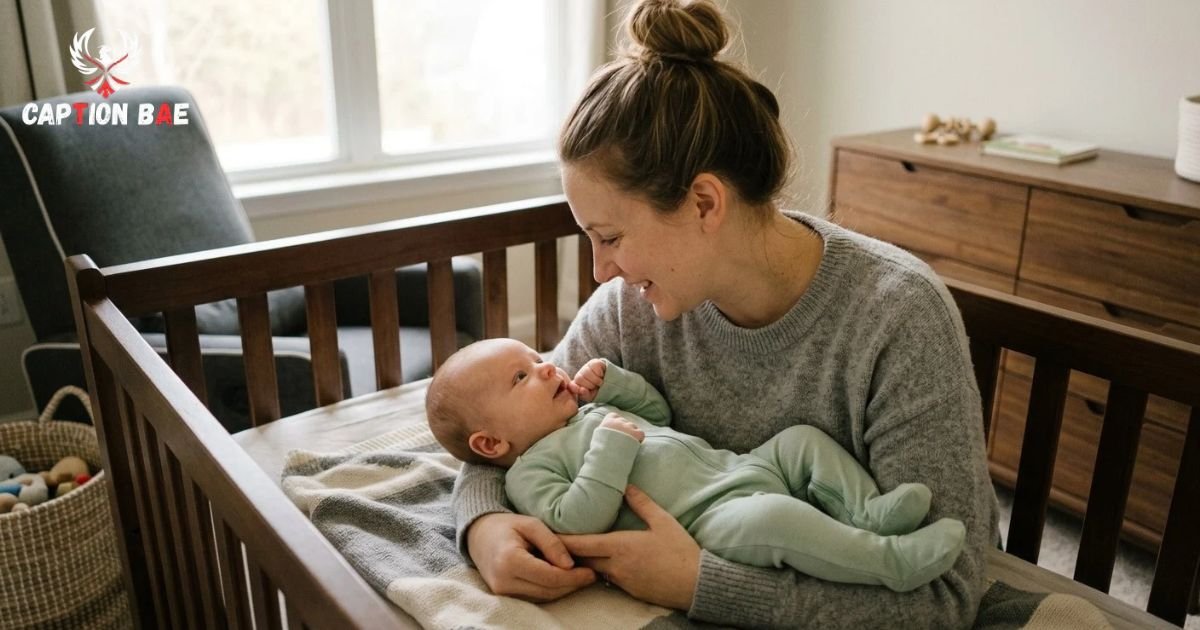
A typical 9-week-old smiles at familiar faces, calms when you talk to them or pick them up, makes sounds other than crying, follows you with their eyes, and lifts their head during tummy time. They sleep about 14 to 17 hours a day in short stretches, feed every few hours, and may cry more than they ever will again. Every baby moves at their own pace.
What’s Normal for a 9-Week-Old Baby?
A 9-week-old is about two months old, right at the CDC’s 2-month checkpoint. “Normal” here is a range, not a single number.
The CDC defines milestones as skills that most children, 75% or more, can do by a certain age. In other words, a milestone is something most babies do by that age, not something every baby does on a set date. Missing one skill is not a verdict.
9-Week-Old Milestones: The CDC 2-Month Checklist
Here’s what most babies are doing by about two months, grouped by skill area.
| Area | What most babies do by 2 months |
| Social & emotional | Calms down when spoken to or picked up, seems happy to see you, and smiles when you talk or smile at them. Also look at your face. |
| Language | Makes sounds other than crying and reacts to loud sounds |
| Thinking | Watches you as you move and looks at a toy for several seconds |
| Movement | Holds the head up on the tummy, moves both arms and both legs, and briefly opens the hands Milestones In Action : By 2 Months +5 |
Think of this list as a mirror, not a test. If you’ve seen most of these, you’re in good shape.
What if my baby isn’t doing all of these yet?
Take a breath. Babies bloom on different schedules.
Two things are worth knowing:
- Born early? The CDC says to use your baby’s corrected age if they arrived more than 3 weeks early. A baby born six weeks early and now 9 weeks old has a corrected age of about 3 weeks.
- Still worried? The CDC notes that milestone checklists are not a substitute for standardized developmental screening. If you have concerns, tell your pediatrician and ask about screening.
How Does a 9-Week-Old Move, See and Hear?
Head control and tummy time
Your baby’s neck is getting stronger every week. According to Mayo Clinic, by two months most babies can support their head on their own when you hold them. Lifting the head and chest on the elbows usually comes closer to month three.
Tummy time is how they build that strength. Pediatricians recommend 15 to 30 minutes of total tummy time per day by about 2 months.
That sounds like a lot. It isn’t, if you split it up:
- Do 5 or so short sessions of 3–6 minutes spread across the day.
- Stay with your baby the whole time. Tummy time is for awake, watched babies only.
- Skip it right after a feed, since a full belly can make babies fussy.
- Get down on the floor and make a noise or hold a toy up. Mayo notes that many babies fuss on their tummies at first, and short, repeated sessions still help.
Regular tummy time also helps prevent flat spots on the back of the head.
How far can a 9-week-old see?
About 12 inches clearly, which is roughly the distance from your face to theirs during a feed. The Bump says that by now a baby’s eyes should be working together and tracking.
Faces are their favorite thing to look at. Mayo notes that babies pay the most attention to faces in the first three months. Color vision is still developing, so clear, simple pictures and photos of familiar faces work well.
If their eyes still look crossed, get stuck in one position, or don’t follow objects, mention it to your pediatrician.
Hearing and “talking”
Your baby is listening hard. Many 9-week-olds coo and repeat vowel sounds when you talk or play with them. Answer their sounds like a real conversation and watch their faces light up.
Read More: 7 Month Old Baby Reported Missing in Yucaipa: What Happened to Emmanuel Haro?
How Much Should a 9-Week-Old Sleep?
| Sleep factor | What’s typical at about 2 months |
| Total sleep in 24 hours | About 14–17 hours, per the National Sleep Foundation range, though 11–13 or 18–19 hours can also be healthy for some babies |
| Naps | Often 4–5 naps a day |
| Awake time between sleeps | Short, roughly 45 minutes to under 2 hours. Most babies land around 1–1½ hours. |
| Longest night stretch | Often 3–6 hours, with some babies going longer and many still waking every few hours 2 Month Old Sleep Schedule: Wake Windows, Naps & Night Sleep +2 |
Different sources give slightly different numbers. That’s normal, because babies really do vary. The 14–17 hour range is the best-supported benchmark.
One illustrative day (not a schedule)
You don’t need a rigid clock. Most days at this age follow a loose wake → feed → sleep loop:
- Wake and feed.
- Stay awake for 45–90 minutes: talk, tummy time, a change of scenery.
- Nap.
- Repeat 4–5 times.
- Early evening: a calm bedtime routine, then a longer night sleep with feeds.
Watch your baby, not the clock. Yawning, staring off, and fussing mean it’s nap time. Waiting for an obvious meltdown usually means you’re already late.
Can a 9-week-old sleep through the night?
Not the way adults mean it. At this age, “through the night” usually means a stretch of about five to six hours, and some babies manage six to eight. Many still wake every 2–4 hours to eat, and that’s healthy.
You can nudge night sleep along gently:
- Get daylight during the day. Rhythm-building hormones are starting to ramp up, so daytime light and dark, quiet nights help.
- Keep night feeds dull. Low lights, few words, then back to sleep.
- Use a short, repeatable bedtime routine, such as a feed, a clean diaper and a lullaby.
Safe sleep basics (AAP)
Safe sleep matters more than any schedule. Follow these every nap and every night:
- Back to sleep, every time. The AAP emphasizes placing babies on their backs in an uncluttered crib next to the parents’ bed.
- Flat and firm. AAP-aligned guidance says surfaces inclined more than 10 degrees are unsafe for infant sleep.
- Share the room, not the bed. The AAP recommends a separate infant sleep surface in the parents’ room, ideally for at least the first six months.
- Keep it empty. No pillows, blankets or bumper pads in the sleep space.
- Move them when they doze elsewhere. If your baby falls asleep in a car seat, stroller or swing, move them to a firm sleep surface as soon as possible.
- Know when to stop swaddling. Swaddling can calm a baby, but stop as soon as they start trying to roll.
Read More: 8 Months Old Baby Caption: 150+ Cute, Funny & Sweet Ideas
How Much Should a 9-Week-Old Eat?
Feed on demand. For young babies, feeding whenever they show hunger is the standard approach.
| Breastfed | Formula-fed | |
| How often | About 7–12 feeds in 24 hours, depending on the source and the baby | Roughly six to eight feeds a day |
| How much | Hard to measure. Watch your baby and their diapers. | About 4–5 ounces every 3–4 hours at around 2 months How Can You Get Your Baby on a Feeding Schedule? +3 |
Over a full day, expressed milk volumes of roughly 24–30 ounces are typical for babies in this range. The Bump advises keeping bottle feeds under about 32 ounces in 24 hours.
How do I know my baby is eating enough?
Look for these signs:
- Wet diapers: a common benchmark is at least five a day.
- Mood: your baby is alert, content and active between feeds.
- Growth: steady weight gain at checkups.
- Poop: it varies a lot. Anywhere from several times a day to about once a week can be normal at this age.
Growth spurts, “leaps” and growth charts
Some days your baby will seem hungrier than usual for a stretch, then settle back down. That’s common. Feed on demand and call your pediatrician if feeding seems hard or diapers drop off.
You may also hear about “developmental leaps” around eight weeks. Those charts are popular with parents, but they’re a parenting framework, not established pediatric guidance. What’s well documented is the crying curve, which comes next.
On growth: The Bump says babies gain about an inch in length and two pounds this month on average, but not at a steady pace. Your pediatrician plots your baby on a percentile chart. What matters most is that your baby follows their own curve.
Why Is My 9-Week-Old Crying So Much?
Because you’re probably at the peak of the normal crying curve.
The Period of PURPLE Crying program says crying increases from around 2 weeks, peaks at about two months, then eases at three to four months. Mayo puts the peak around six weeks, so somewhere between six and nine weeks is the usual range.
It can feel relentless. According to the program, crying can last as much as five hours a day or more, often in the late afternoon and evening. A crying baby can also look like they’re in pain even when they’re not.
What helps
- Run the checklist: feed, diaper, temperature. Dress them comfortably. The NSW Children’s Hospital says to check the basics first, then try other soothing.
- Hold them close. Mayo says you can’t spoil a baby with too much attention.
- Watch for overload. Turning away or arching the back can mean they’re overstimulated and need downtime.
- Take a break if you’re at your limit. Put your baby down safely on their back in the crib and step away for a few minutes, or hand them to someone for 5–10 minutes.
Never shake a baby. Shaking is never OK, however exhausted you are.
Read More: 5 Month Old Baby Captions: 100+ Cute, Sweet & Loving Instagram Ideas
The 2-Month Checkup & Vaccines
Around this age, most babies have their 2-month well-child visit. Your pediatrician will check growth and development and give the first doses of several vaccines.
The standard infant series at 2 months, per the CDC table, includes first doses of rotavirus, DTaP, Hib, pneumococcal and polio vaccines. Most of these continue for 4 months.
Important: federal vaccine guidance changed in 2026. The CDC revised its schedule in January and moved some vaccines, including rotavirus, into a “shared clinical decision-making” category. Medical groups have challenged those changes, including in court. The AAP published its own schedule, which stays consistent with the 2025 schedule.
[VERIFY BEFORE PUBLISH: this status changes quickly. Confirm the current federal and AAP schedules and update this paragraph.]
Your pediatrician is the best person to talk this through. Bring your questions to the visit.
When to Call the Doctor: The Green-Yellow-Red Check
Use this table when you’re unsure. It sorts common worries into three levels.
[REVIEWER NOTE: clinician review required for the Red row before publishing.]
| Level | What it looks like | What to do |
| Green: normal | Fussy evenings. Waking every 2–4 hours. About 14–17 hours of sleep. Wide variation in poop. Smiles and coos. | Relax. Keep feeding, sleeping safely and playing. |
| Yellow: tell your pediatrician | Trouble feeding, no reaction to loud sounds, not following moving objects, or a body that seems very stiff or very floppy. Also: no smiles yet, eyes that stay crossed, or white patches in the mouth. | Call the office or raise it at your next visit. If it’s clearly getting worse, call now. |
| Red: act now | A rectal temperature of 100.4°F (38°C) or higher. Trouble breathing. A baby who seems very ill or won’t wake to feed. | Call your pediatrician immediately. If you can’t reach them, go to the nearest emergency department. For an emergency, call 911. Infant development: Birth to 3 months +2 |
On fever: HealthyChildren.org says for a baby 3 months or younger with a rectal temperature of 100.4°F or higher, call your pediatrician immediately, even if there are no other symptoms. Also, don’t give fever medicine before your baby has been seen.
And trust your gut. Mayo says that if your instincts tell you to call, do it.
Read More: 9 Months Old Baby Caption Ideas for Every Precious Moment
Expert Insight: What Parents Wish They’d Known About Week 9
[CLIENT INPUT NEEDED: add a pediatrician or lactation consultant quote here, with credentials and permission. Add 1–2 real parent observations if available. Don’t publish this section with placeholder text.]
A typical story: a parent has been told their baby “should” be sleeping longer, and spends weeks worried. Then a visit shows the baby is growing well and on track. The “problem” was a number from a chart, not their baby.
If your baby is feeding well, growing, alert between naps and meeting most milestones, you’re doing it right.
5 Easy Ways to Play With Your 9-Week-Old
You don’t need toys. Your face is the best one.
- Have a “conversation.” When your baby cooks, cook back and pause. Making silly sounds back and forth strengthens your bond.
- Make tummy time fun. Lie down face to face, or hold a toy just ahead of them.
- Try a soft rattle. Simple, soft rattles help babies learn that their actions make sounds.
- Show faces. Photos of family or a simple face book hold their attention.
- Bicycle their legs. Lay them on their back and gently move their legs. The Bump notes it can also help relieve trapped gas.
Taking Care of You
New parenthood is a lot. Mayo says some caregivers go through an emotional roller coaster early on, which is common. Talk to your provider if you feel severely sad, or sad for more than a few weeks.
If you want to talk to someone now, the National Maternal Mental Health Hotline offers free, confidential support by call or text at 1-833-TLC-MAMA (1-833-852-6262), any time. It isn’t a crisis line. If you’re in a suicidal crisis, call or text 988.
Asking for help isn’t failing. It’s good parenting.
Conclusion
At 9 weeks, development is a range, not a deadline. Most babies smile, coo, track faces and lift their heads. They sleep about 14–17 hours in short chunks, feed on demand and cry near their peak. Sleep them on their back in a flat, empty crib. Call your pediatrician right away for a rectal temperature of 100.4°F or higher, and mention anything that worries you.
FAQs
Is it normal if my 9-week-old doesn’t smile yet?
Many babies start smiling around 2 months, and the CDC lists smiling when you talk or smile at them as a typical 2-month skill. If your baby isn’t smiling yet, it’s worth mentioning to your pediatrician, who can check the rest of their development.
How long should tummy time be at 2 months?
Pediatricians recommend about 15 to 30 minutes in total per day by around 2 months. Break it into short sessions while your baby is awake and supervised.
Can I swaddle a 9-week-old?
Swaddling can help calm a baby and is fine for sleep, always on their back. Stop as soon as your baby starts trying to roll.
How many wet diapers should a 9-week-old have?
A common benchmark is at least five a day. Also watch for an alert, content baby between feeds and steady weight gain at checkups.
Is my baby having a growth spurt?
Short stretches of extra hunger or fussiness are common. Feed on demand and check diapers. If feeding seems hard or diapers drop off, call your pediatrician.
What temperature counts as a fever in a baby this young?
A rectal temperature of 100.4°F (38°C) or higher. For babies 3 months or younger, call your pediatrician immediately, and don’t give fever medicine before your baby is seen.
When is the next checkup?
Many infant vaccine series continue at 4 months, and many practices schedule the next well visit then. Confirm the timing with your pediatrician’s office.
