

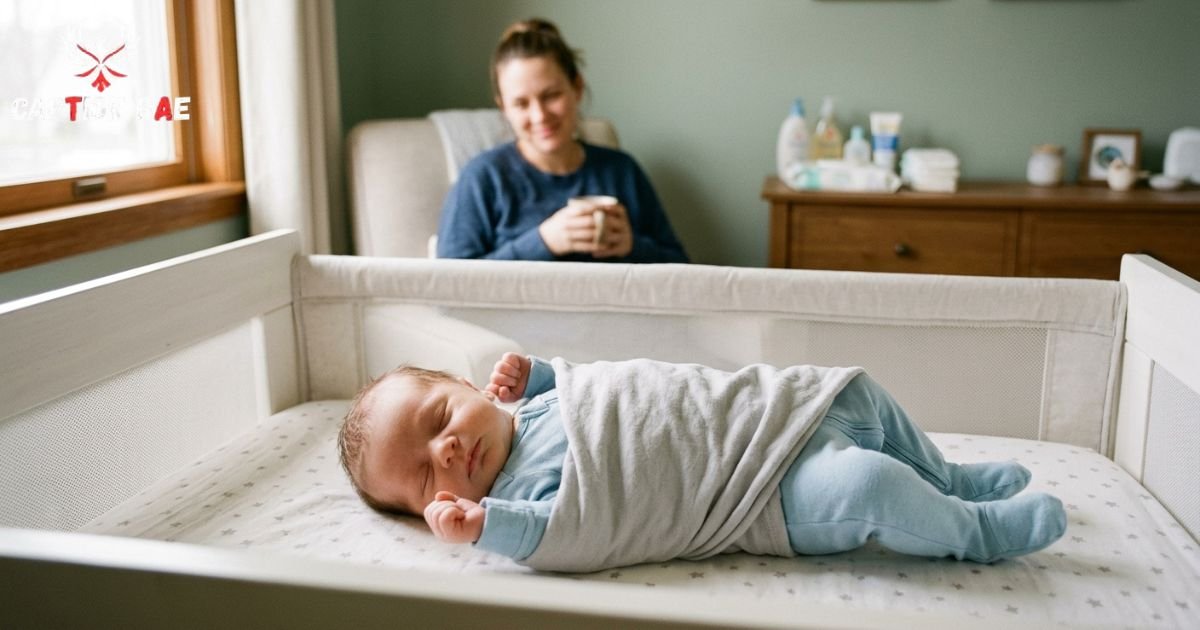
1 month old sleep, at a glance: Total sleep 14–17 hours/24 hrs · Wake windows 30–90 minutes · Naps 6–8 short naps/day (10 min–2+ hrs each) · Night sleep 9–12 hours with multiple wakings to feed · No sleep training yet babies this age physically can’t self-soothe or go long stretches without eating.
How Much Should a 1 Month Old Sleep?
A 1-month-old needs 14 to 17 hours of sleep per day, according to the National Sleep Foundation, the same broad range doctors use for the entire newborn period. That sleep isn’t concentrated at night. It’s scattered across the whole 24-hour clock in short bursts, because your baby’s internal clock (circadian rhythm) hasn’t switched on yet.
Instead of chasing an exact hour count, pediatricians generally suggest a simpler gauge: watch your baby’s mood, feeding, and alertness. A baby who’s feeding well, gaining weight, and has calm awake periods is getting enough sleep even if the hours look messy on paper.
1 Month Old Wake Windows
A wake window is how long your baby can comfortably stay awake before needing to sleep again. At 1 month, that window is short.
| Time of day | Typical wake window |
| Morning | 30–45 minutes |
| Midday | 45–60 minutes |
| Evening (pre-bedtime) | Up to 90 minutes |
Most 1-month-olds can only handle 30 to 90 minutes of awake time including feeding and a diaper change before they’re ready to sleep again. Miss that window and your baby can tip into “overtired,” which paradoxically makes falling asleep harder, not easier. Watching for early tired cues (looking away, unfocused gaze, rubbing their face on you) matters more than watching the clock.
Read More: Baby Captions For Instagram 100+ Cute, Funny & Sweet (2026)
Sample 1 Month Old Sleep Schedule
Every baby’s day will look different, and that’s normal at this age. Here’s one realistic example of how a 24-hour period might play out:
| Time | Activity |
| 7:00 AM | Wake, feed |
| 7:45–8:30 AM | Nap 1 |
| 9:15 AM | Feed |
| 10:00–11:15 AM | Nap 2 |
| 12:00 PM | Feed |
| 12:45–2:00 PM | Nap 3 |
| 2:45 PM | Feed |
| 3:30–4:30 PM | Nap 4 |
| 5:15 PM | Feed |
| 6:00–6:30 PM | Nap 5 (catnap) |
| 7:00 PM | Feed, bedtime routine begins |
| 7:30 PM–7:00 AM | Night sleep, with 2–4 wake-ups to feed |
Treat this as a template, not a target. Nap lengths, wake times, and bedtime will shift day to day sometimes hour to hour.
The 3-Step Newborn Rhythm: Eat, Play, Sleep
Rather than trying to schedule your baby by the clock, most sleep experts recommend a simple sequencing trick: feed, then engage briefly, then sleep instead of feeding your baby to sleep every time.
Here’s why the order matters: if a baby always falls asleep while feeding, they can start to need feeding as their only way to fall asleep, even for non-hunger wake-ups overnight. Building in even a two-minute “play” window (a diaper change and some eye contact counts) after feeding before sleep starts to gently separate eating from sleeping.
At 1 month, “play” isn’t a toy or a mat. It’s a burp, a nappy change, a little face time. That’s enough.
Can a 1 Month Old Sleep Through the Night?
No and that’s expected, not a problem to fix. At this age, “sleeping through the night” realistically means a single 5–6 hour stretch, not eight uninterrupted hours. A 1-month-old’s stomach is tiny and empties quickly, so babies need to eat every 2–3 hours around the clock, including overnight. Most won’t reach a longer, more consolidated night stretch until closer to 3–4 months.
Read More: 100+ Best Baby Arrival Announcement Captions for Instagram 2026
Why Does My 1 Month Old Wake Up Crying at Night?
Frequent night waking at 1 month is almost always about hunger or comfort, not a sleep problem. Because your baby’s circadian rhythm hasn’t developed yet, there’s no biological reason for them to distinguish day from night. When your baby wakes crying, work through the basics in order: is it feeding time (every 2–3 hours is typical)? Do they need a diaper change? Are they seeking comfort after a startle (the Moro reflex can wake babies suddenly)? At 1 month, responding promptly doesn’t create bad habits; it’s what this stage of development calls for.
Common Sleep Hiccups at 1 Month
The “Witching Hour”
Many parents notice a stretch often late afternoon into evening where their baby becomes unusually fussy and hard to settle, sometimes called the witching hour. It tends to cluster around growth spurts and simple end-of-day overstimulation, and it typically eases as babies near 8–12 weeks. Shortening wake windows and dimming lights earlier in the evening can help take the edge off.
Growth Spurts
Growth spurts commonly hit around 2–3 weeks and again near 6 weeks. During a spurt, expect more frequent night wakings and hungrier feeds for a few days. This is temporary and not a sign anything is wrong with your baby’s sleep.
Day/Night Confusion
Some 1-month-olds sleep more during the day than at night, a leftover pattern from the womb, where daytime movement often lulled them to sleep. To help reset it: keep the house bright and normally noisy during the day, and dim lights with quiet, low-stimulation handling at night. Most babies sort this out on their own by around 8 weeks.
Read More: 10 Months Old Baby Caption Ideas for Every Precious Moment
Safe Sleep Basics for a 1 Month Old
The American Academy of Pediatrics recommends these safe sleep practices for every sleep period, day or night:
- Back to sleep, every time never stomach or side, for naps or bedtime
- Firm, flat sleep surface a crib, bassinet, or portable play yard with a fitted sheet only
- Nothing else in the sleep space no pillows, blankets, loose bedding, or plush toys
- Room-share without bed-sharing keep baby’s sleep space in your room for at least the first 6 months
- Avoid overheating dress for room temperature, and don’t cover the head
- Keep smoke exposure away secondhand smoke raises SIDS risk
Should You Start Sleep Training at 1 Month?
No sleep training isn’t appropriate at this age. Babies this young are developmentally unable to self-soothe or reliably go long stretches without a feed, and formal sleep training methods aren’t recommended by pediatric sleep experts until closer to 4–6 months, once a more regular circadian rhythm and feeding pattern are established. Right now, your job is simpler: respond, feed, and gently start the eat-play-sleep sequence when you can.
Read More:12 Months Old Baby Caption for First Birthday Memories
One Real Night: What This Actually Looks Like
On paper, a “9 to 12 hour night stretch” sounds almost reasonable. In practice, it looks like this: bedtime at 7:30, awake at 9:45 to feed, back down by 10:15, awake again at 12:40, a longer stretch until 3:30, feed, back down, awake at 6:00 ready to start the day. That’s four wake-ups and it’s completely within the range of normal for a 1-month-old.
The number that actually matters isn’t the clock. It’s whether your baby is feeding well, has enough wet and dirty diapers, and settles again after being fed or changed. If those boxes are checked, an unpredictable night isn’t a red flag, it’s just what this month looks like.
Read More: 9 Months Old Baby Caption Ideas for Every Precious Moment
1 Month vs. 2 Month Sleep: What Changes
| 1 Month | 2 Months | |
| Total sleep | 14–17 hours | 14–17 hours |
| Wake windows | 30–90 minutes | 45–105 minutes |
| Naps | 6–8, unpredictable | 4–5, slightly more consistent |
| Night stretch | 5–6 hours | Often 6–8 hours |
| Circadian rhythm | Not yet developed | Beginning to emerge |
The biggest shift between month one and month two is length of wake windows and nap consolidation naps start merging into fewer, longer stretches instead of many short catnaps.
Conclusion
A 1-month-old baby’s sleep schedule is still developing, so there is no need to expect a strict routine. Short wake windows, frequent naps, nighttime waking, and changing sleep patterns are all normal at this age. Focus on your baby’s hunger and tiredness cues, provide a calm sleep environment, and follow safe-sleep practices. As your baby grows, their sleep will gradually become more predictable.
FAQs
How many hours should a 1 month old sleep?
14–17 hours total across a 24-hour period, spread over roughly 6–8 naps plus interrupted night sleep. This is a range, not a strict target to watch your baby’s mood and feeding as the better guide.
Can a 1 month old sleep too much?
It’s uncommon, but if your baby is sleeping well above 17–18 hours a day and struggling to wake for feeds or gain weight, check in with your pediatrician.
What time should a 1 month old go to bed?
There’s no fixed “right” bedtime yet many 1-month-olds naturally have a late, irregular bedtime (sometimes 9–11 PM) that gradually shifts earlier by 3–4 months.
Is it normal for my 1 month old to only nap 20–30 minutes?
Yes. Nap length is highly variable at this age and can range from 10 minutes to over 2 hours, even within the same day.
When will my baby start sleeping longer stretches at night?
Most babies begin consolidating longer night stretches somewhere between 3 and 4 months, as their circadian rhythm and feeding needs mature.
