

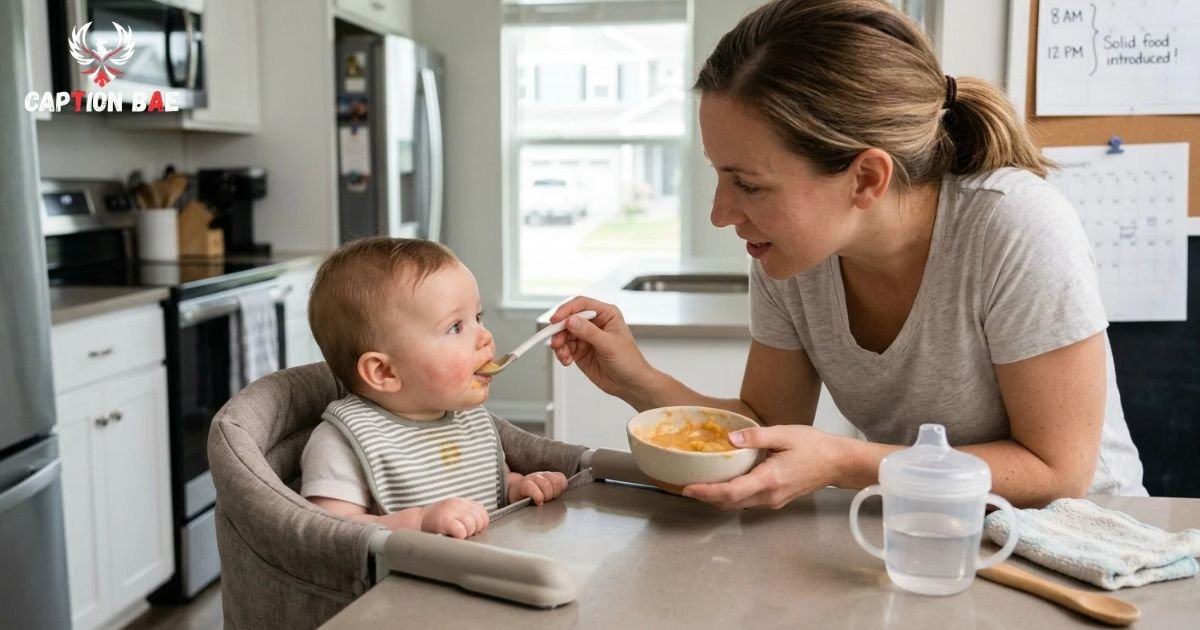
A 6-month-old still gets most of their nutrition from breast milk or formula, plus one or two tiny solid meals a day. By this age, bottle-fed babies often drink 6 to 8 ounces at each of 4 or 5 feedings in 24 hours. Solid meals start small, around 1 or 2 tablespoons of food. Follow your baby’s hunger and fullness cues, not the clock.
Is Your Baby Ready? 6 Signs to Check First
A schedule only works if your baby is ready to eat. Age matters, but development matters more.
The CDC says most babies can begin solid foods at about 6 months, and that starting before 4 months is not recommended. Look for these signs. Your baby sits up alone or with support, controls their head and neck, opens their mouth when you offer food, swallows food instead of pushing it back out, brings objects to their mouth, and tries to grasp small things.
Here is the quick version:
- Sits up alone or with support
- Holds their head steady
- Opens wide when food comes near
- Swallows food instead of pushing it out
- Brings toys to their mouth
- Reaches for small objects
If your baby is missing several of these, wait a week or two and check again. Some babies aren’t ready until closer to 7 months, and that is normal. Talk with your pediatrician if you’re unsure.
Read More: 7-Month-Old Baby Milestones Physical, Cognitive, Social & What’s Normal
Sample 6 Month Old Feeding Schedule
Here is a sample day for a baby who takes three naps. It is an example, not a rule. Every baby has their own rhythm, so adjust it to fit yours.
| Time | What’s happening | Notes |
| 6:30 a.m. | Wake up + milk | Breast or bottle |
| 7:30 a.m. | Solid meal (1–2 tbsp to start) | About an hour after milk |
| 7:50 a.m. | Optional top-off milk | Only if still hungry |
| 8:30–10:00 a.m. | Nap 1 | |
| 10:00 a.m. | Milk | |
| 12:30 p.m. | Milk | |
| 1:00–2:30 p.m. | Nap 2 | |
| 2:45 p.m. | Milk | |
| 4:30–5:00 p.m. | Short nap 3 | |
| 5:00 p.m. | Milk | |
| 5:45 p.m. | Optional second solid meal | Only if baby enjoys solids |
| 6:30 p.m. | Milk (start of bedtime routine) | Before bath and books |
| 7:00 p.m. | Bedtime |
Two things to know about this table. Only one solid meal is needed while you’re just starting. And the total number of milk feeds will vary a lot from baby to baby.
The nap times above follow a common pattern. A 6- to 7-month-old is typically awake for about 2 to 2.5 hours at a time and takes three naps a day.
If you breastfeed on demand
You don’t need to watch the clock. Nurse when your baby is hungry, and offer a solid meal about an hour after a nursing session so the baby comes to the table a little hungry. Solid Starts says many babies at this age still nurse 8 to 12 times a day, and that is fine if your baby is growing and thriving.
If you bottle-feed or combo feed
Use the table as a rough guide. Solid Starts suggests 24 to 32 fluid ounces of breast milk or formula a day at this age. If you give 5 or 6 bottles, that works out to roughly 4 to 6 ounces each. Your baby may take more or less.
Feeding and sleep together
Do you want to avoid feeding your baby to sleep? Solid Starts suggests finishing any top-off feed at least 30 minutes before naptime and keeping the baby awake while they eat. You can also move the bedtime bottle or nursing session to the start of the routine, before bath and books.
Read More: 8 Months Old Baby Caption: 150+ Cute, Funny & Sweet Ideas
How Much Should a 6 Month Old Eat and Drink?
Advice on the internet seems to contradict itself. The table below explains why.
| Source says | What it means | Why it differs |
| 4–5 feedings of 6–8 oz (AAP/HealthyChildren) | Bottle-fed volume | Counts only formula bottles |
| 5–6 times a day (CDC) | Total eating times | Includes milk and food |
| 6–8 bottles (Solid Starts) | Milk feeds for many babies | Smaller feeds, includes night bottles |
| 1 solid meal (Solid Starts) | Starting out | For brand-new eaters |
| 2–3 solid meals (Cleveland Clinic) | Established eaters | For babies 6–8 months who’ve practiced |
The takeaway: these numbers aren’t fighting each other. They measure different things. The CDC’s guidance is to offer something to eat or drink every 2 to 3 hours, about 5 or 6 times a day. Cleveland Clinic says babies of six to eight months typically eat two to three solid meals a day. That describes where your baby is headed, not where they start.
Formula amounts
On average, babies need about 2½ ounces of formula a day for every pound of body weight. Most babies don’t need more than about 32 ounces of formula in 24 hours. If your baby always wants more or less than this, check with your pediatrician.
Solid food amounts
Start tiny. One or two tablespoons is plenty. Solid Starts calls this stage practice, so don’t worry about how much the baby actually eats.
Water
Small sips are fine. Solid Starts suggests offering water in an open cup or straw cup at meals, under 2 ounces per meal and no more than 4 ounces a day, unless your pediatrician says otherwise. Too much water can crowd out milk.
What Should a 6 Month Old Eat? A Sample First-Week Menu
Good news: you don’t have to follow a strict food order. The AAP says most babies don’t need foods in a certain order. Choose foods that fit your family, and offer one single-ingredient food at a time so you can spot any reaction.
Here’s a simple example week for the one-meal-a-day stage. It is a sample, not a prescription.
| Day | First food idea | Iron or nutrient boost |
| 1 | Iron-fortified infant oatmeal, thinned with breast milk or formula | Iron |
| 2 | Mashed avocado | Healthy fats |
| 3 | Pureed or very soft-cooked chicken or beef | Iron and zinc |
| 4 | Mashed sweet potato | Vitamin A |
| 5 | Well-cooked, mashed egg | Protein (an allergen, see below) |
| 6 | Mashed lentils or beans | Plant iron |
| 7 | Soft banana or pear | Fiber |
Purees, baby-led weaning, or both? All three work. What matters is that the food is soft and the right shape for a baby, and that your baby sits upright while eating. Choose what fits your family.
Two tips make iron work harder. Pair plant-based iron foods with vitamin C foods, like beans with tomato sauce or a fruit puree. And don’t put cereal in the bottle: the CDC warns it will not help babies sleep longer and could raise choking risk.
Milk First or Solids First?
At this age, milk usually comes first, then solids. Milk is still the main food, and a baby who is too hungry may be too frustrated to try something new.
Timing depends on the source. Taking Cara Babies suggests offering solids 30 to 90 minutes after a breast or bottle feeding. Solid Starts suggests offering milk about 30 minutes before a meal, as an “appetizer.” Either way, don’t give the meal to an empty, screaming tummy. And it’s fine to be flexible on a busy day.
Read More: 5 Month Old Baby Captions: 100+ Cute, Sweet & Loving Instagram Ideas
The Three-Beat Feed: Milk, Meal, Top-Off
Here’s a simple way to remember the rhythm. Call it the Three-Beat Feed:
- Milk: a short feed before the meal so baby isn’t desperate
- Meal: table time for 1–2 tablespoons and lots of exploring
- Top-off: more milk afterward, only if baby still seems hungry
Solid Starts recommends waiting about 15 to 20 minutes after solids before offering that top-off. Over the coming months, the top-off shrinks as solid meals get bigger.
(Reviewer note: this framework is my naming of a commonly described pattern. Please have your clinical reviewer confirm the wording and add a brief expert quote if they can.)
When and How to Introduce Peanut and Egg
This is where guidance has changed. Years ago, parents were told to delay allergy-causing foods. We now know that waiting doesn’t help.
Current guidance says peanut and egg should be introduced around 6 months, but not before 4 months, and other allergens around the same time. Common allergens include peanut, egg, cow’s milk products, tree nuts, wheat, shellfish, fish, and soy.
Some practical points:
- Use a safe form. Never give whole peanuts or tree nuts to a child under 5. Use smooth nut butters thinned out, or baby peanut puffs.
- Keep it going. Once you introduce an allergen, it helps to keep it in the diet regularly.
- Talk to your doctor first if your baby is high-risk. Babies with severe eczema or egg allergy are considered high risk for peanut allergy, and guidance suggests introducing peanuts between 4 and 6 months for them. Ask your pediatrician how to do this safely for your baby.
Know the signs of an allergic reaction before the first bite. If you see hives, swelling, vomiting, or trouble breathing, call emergency services. (Reviewer: please add your preferred reaction-symptom list here and link to it.)
Safety Basics: Gagging, Choking, Honey and Foods to Skip
Gagging and choking are not the same. Gagging is noisy and usually resolves on its own as babies learn. Choking is usually quiet, because the airway is blocked. Learn infant CPR before you start solids. (Reviewer: please verify this wording and link to your preferred infant CPR resource.)
Keep these rules handy:
- Always supervise meals, and keep the baby sitting upright.
- No honey before 12 months. Honey can cause botulism in children under 12 months, including honey in yogurt, cereals, or crackers.
- Cut round foods small. Cut small round foods like grapes, cherries, berries, and tomatoes into small pieces.
- Skip unpasteurized foods and drinks. They can carry germs that are harmful to babies.
- Skip added salt and sugar.
- Skip cow’s milk as a drink for now. Yogurt and cheese are fine, but milk doesn’t replace breast milk or formula in the first year.
Iron, Zinc & Vitamin D: The Nutrients That Matter Now
Solids aren’t just for fun. Around 6 months, your baby’s built-in iron stores start running low.
The AAP says partly or fully breastfed babies should get an iron supplement starting at 4 months, until they eat enough iron-containing foods, such as iron-fortified cereals. Formula is iron-fortified, so formula-fed babies rarely need extra. Meat, beans, and fortified cereals are good first foods for this reason.
Vitamin D is the other one to know. The AAP says all brRead More:eastfed babies, and formula-fed babies drinking less than 27 ounces a day, should take a vitamin D supplement. Solids don’t replace those drops. Ask your pediatrician about the right dose for your baby.
Read More: 6 Months Old Baby Caption Sweet Moments of Our Little Angel
Common Problems (and What to Do)
My baby still wakes at night.
This is common. Huckleberry says it’s common at this age to wake to eat once or twice a night, and that some 6-month-olds go 7 to 8 hours without a feed. Taking Cara Babies notes that many babies can sleep 10 to 12 hours without a feeding, while some do best keeping one. If you’re unsure, ask your pediatrician.
My baby refuses solids.
That’s very normal. Try again in a day or two, pick a time when the baby is happy and rested, and let them explore. Solid Start notes it’s completely okay to skip a day.
Growth spurts and teething.
Babies may want more milk for a few days, or less food. Follow their cues and return to your routine when things settle.
Daycare and travel.
Share your baby’s current routine with caregivers, including which foods you’ve introduced. Keep it flexible.
Conclusion
A 6-month-old feeding schedule should balance breast milk or formula with age-appropriate solid foods as your baby gradually explores new tastes and textures. Offer small portions of nutritious foods, introduce new foods one at a time when appropriate, and follow your baby’s hunger and fullness cues. Every baby develops differently, so use a flexible routine and speak with your pediatrician if you have concerns about feeding, allergies, growth, or readiness for solids.
FAQs
How many times a day should a 6-month-old eat?
The CDC suggests something to eat or drink every 2 to 3 hours, about 5 or 6 times a day. Most of those are milk feeds, with one or two tiny solid meals.
How many solid meals should a 6-month-old have?
Start with one. Add a second when your baby is enjoying solids. Cleveland Clinic says babies of 6 to 8 months typically eat two to three solid meals a day. That is where you’re heading, not where you start.
How many ounces of formula does a 6-month-old need?
Bottle-fed babies often take 6 to 8 ounces at each of 4 or 5 feedings, or about 2½ ounces per pound of body weight per day. Most babies don’t need more than about 32 ounces a day..
Can a 6-month-old have water?
Yes, in small sips. Keep it under 2 ounces per meal and 4 ounces a day, unless your pediatrician says otherwise.
Should I wake my baby to feed?
Usually not, if your baby is growing well. Talk with your pediatrician if you have concerns about weight gain.
What if my baby only wants milk?
That is okay for now, since milk is still the main food. Keep offering solids for practice and don’t push.
How do I know my baby is eating enough?
Regular wet and dirty diapers are signs your baby is eating enough, and your child’s doctor can check growth at well-baby visits. Call your pediatrician if you see fewer wet diapers, poor weight gain, or your baby seems unusually sleepy or hard to feed.
Can I put cereal in the bottle?
No. It won’t help babies sleep longer, and it could raise choking risk. Serve cereal with a spoon.
