

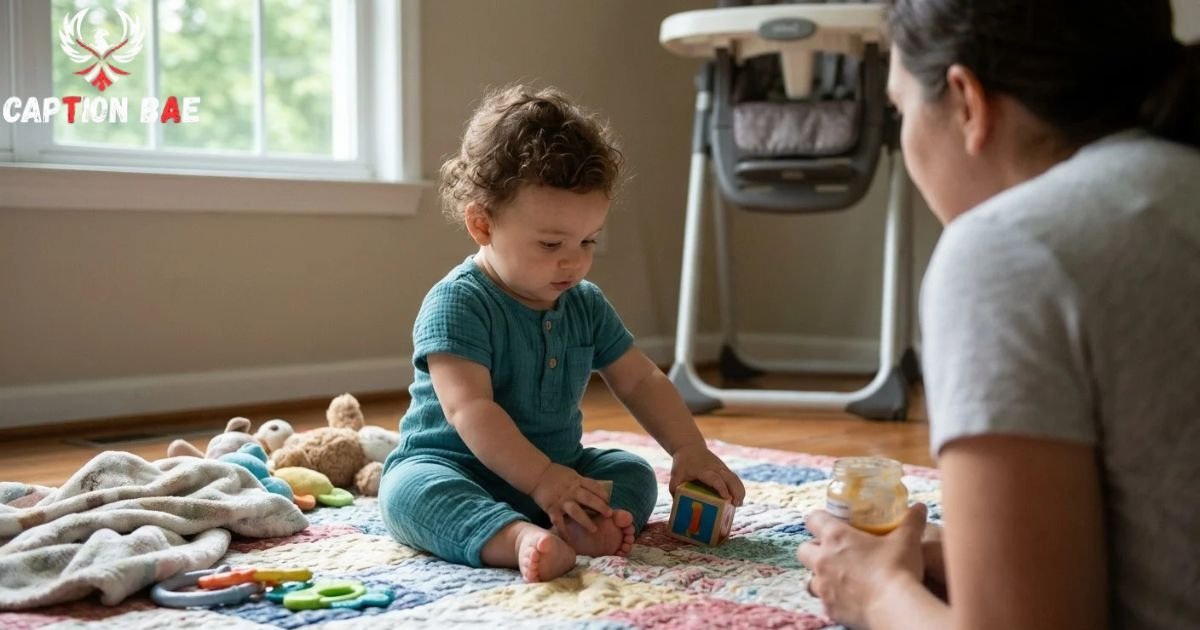
An 8 month old baby is typically sitting, moving across the floor in some way (crawling, scooting, or rolling), picking up small objects, babbling strings like “ba-ba-ba,” and showing stranger or separation anxiety. They still drink breast milk or formula and are eating solids and finger foods. Babies develop at different speeds, so a range of “normal” is wide.
What Is Normal for an 8 Month Old Baby?
Here’s the big picture at a glance:
| Area | What’s typical at 8 months | Mention to your pediatrician if… |
| Movement | Sits alone or with a little support; scoots, rocks, or crawls; may pull up to stand | Not sitting or crawling by the end of month nine |
| Hands | Passes toys hand to hand; starts using thumb and finger to pick up small bits | Uses one side of the body much more than the other |
| Talking | Babbles chains of sounds; may say “mama/dada” without meaning it yet | Doesn’t respond to their name |
| Thinking | Looks for dropped or hidden things; learns cause and effect | Doesn’t look for hidden objects by the end of month nine |
| Feelings | Wary of strangers; upset when you leave | No eye contact or social interest |
| Sleep | Two daytime naps; nighttime sleep may dip | Chronic, severe sleep trouble that worries you |
| Eating | Milk plus several solid-food meals, with soft finger foods | Refuses all solids, or coughs or gags constantly |
Based on guidance from Mayo Clinic, WebMD, and the CDC. Every baby is different.
No 8-month checklist? Here’s how to use the CDC’s lists
Here’s something most parenting sites skip. The CDC doesn’t publish an 8-month milestone checklist. Its checklists come at 2, 4, 6, 9, 12, 15, 18, and 30 months.
So how do you check on an 8-month-old? Look at both lists:
- Behind the 6-month list? Mention it to your pediatrician soon.
- Ahead of the 6-month list and working toward the 9-month list? That’s right on track.
The CDC defines a milestone as something 75% or more of children can do by that age. That means a quarter of healthy babies haven’t done it yet. The 9-month list is also not a substitute for formal screening. The American Academy of Pediatrics recommends standardized developmental screening at 9, 18, and 30 months.
If your baby was born more than 3 weeks early, use their corrected age (their age counted from their due date, not birth date) when you check the lists.
Verify before publishing: CDC revised its checklists in 2022. Confirm the current 9-month items at cdc.gov/milestones before finalizing any specific milestone wording.
8 Month Old Baby Milestones
Motor skills: sitting, crawling, and pulling up
By now most babies roll both ways and sit on their own. Others need a little support, and that’s fine.
You may see your baby:
- Scoot, rock on hands and knees, or crawl across the room
- Pull up to stand on a couch or low table
- Stand holding on, and soon cruise along furniture
Not crawling yet? Don’t panic. WebMD notes that some babies take a few extra months to get moving, and a few go straight from rolling to walking without crawling at all. What matters is that your baby is finding ways to move and bear weight on their legs. If they don’t crawl or sit on their own by the end of month nine, or they use one side of the body more than the other, tell your pediatrician.
Hands: from raking to the pincer grasp
Your baby is getting better at hand-eye coordination. They’ll pass objects from one hand to the other and bring them to their mouth.
Early on, they rake small things toward themselves with the whole hand. Around now, the pincer grasp (thumb and forefinger) starts to develop. This is what helps them pick up soft finger foods and eventually hold a spoon.
Safety rule of thumb: If something fits inside a toilet paper tube, it’s small enough to choke on. Keep it out of reach.
Language: babbling, names, and “no”
At 8 months, babbling gets more complex. You’ll hear chains of sounds like “ba-ba-ba” and “ga-ga,” and possibly a “mama” or “dada” that isn’t aimed at anyone yet.
Most babies this age also:
- Turn toward their name
- Understand simple words like “bye-bye” and often “no”
- Copy sounds, gestures, and facial expressions
- Point with a finger or gesture to “talk”
You can’t count on a clear first word yet, and that’s okay. First words usually come closer to age one.
Thinking: object permanence and cause and effect
Your baby is learning that things still exist when they can’t see them. That’s called object permanence. It’s why peekaboo is suddenly hilarious, and why they’ll look for a toy you hide under a blanket.
They’re also learning cause and effect: “When I drop this, someone picks it up.” (Yes, you’ll be picking up that spoon about 40 times a day. It’s science.)
Why Is My 8 Month Old Suddenly Clingy?
If your happy, easygoing baby is now crying when you leave the room or fussing around grandma, welcome to the “8-month crisis.” It’s a real stage, and it’s a good sign.
What’s happening
Two big brain leaps arrive together:
- Stranger anxiety. Your baby can now tell familiar faces from unfamiliar ones. Even relatives and sitters they used to like may get a tearful response.
- Separation anxiety. Your baby knows you exist when you’re out of sight, but has no sense of time. A two-minute absence can feel like forever.
The American Academy of Pediatrics says this behavior isn’t caused by your parenting or “spoiling,” and the anxiety is evidence of a healthy attachment. It usually peaks between 10 and 18 months and fades during the second half of the second year. Some babies barely show it at all, and that’s normal too.
A 5-step goodbye routine that works
This routine is adapted from AAP and Mustela guidance:
- Time it right. Leave after a nap and a meal. Babies are more anxious when tired, hungry, or sick.
- Make a short, calm goodbye. Say it once, warmly: “I’m going to work. I’ll be back after your snack.”
- Hand off to a distraction. Have the caregiver offer a toy, a mirror, or a bath.
- Leave quickly. Long goodbyes make it harder. Tears usually fade within minutes of you leaving.
- Practice at home. Pause a minute or two before following your crawler into another (baby-proofed) room. Call out to them rather than running back.
At daycare or a sitter’s home: Don’t drop and run. Spend a few extra minutes playing there first, and bring a comfort item like a small blanket.
Mirror play and new fears
You may also notice your baby studying themselves in the mirror, because they’re beginning to realize that’s them. Play along. Touch your nose, then theirs, and name each body part.
New fears can pop up, such as the dark, thunder, or the vacuum cleaner. According to the AAP, the most helpful response is to reduce the trigger (use a night-light, vacuum when they’re not around) and stay calm and close so they can look to you for reassurance.
Read More: Feeding Timetable for a 7-Month-Old: Sample Schedule & Amounts
8 Month Old Sleep: How Much, Naps, and the Regression
How much sleep does an 8 month old need?
Sources don’t agree on one number, and that confuses parents. Here’s how the ranges compare:
| Source | Total sleep per day | Naps |
| WebMD | About 13–14 hours | Two naps, ~1 hour each on average |
| Mustela | ~10 hours at night plus 3–4 hours of naps | Two longer naps (1.5–2 hours) or three shorter ones (~1 hour) |
| Baby-care brand (Happiest Baby) | 12–16 hours | Varies |
Verify before publishing: The AAP-endorsed range for babies 4 to 12 months is generally cited as 12 to 16 hours per 24 hours, including naps. Confirm against the AAP/AASM source and link it.
The takeaway: Aim for roughly 12–15 hours total across night and naps, and judge by your baby’s mood and energy, not a stopwatch. Wake windows (time awake between sleeps) vary a lot. Many families land around 2.5 to 3.5 hours, but that’s a rough estimate, not a rule.
The 8 to 10 month sleep regression
It’s frustrating, but it’s a pattern: many babies sleep worse between 8 and 10 months. Common triggers:
- New skills like crawling and pulling up (babies practice them at 2 a.m.)
- Separation awareness
- Teething
- Too little milk during the day as solids take over, which leads to nighttime hunger
What helps
- Keep your routine consistent. Same bedtime steps, same order, same cues.
- Make sure daytime feeds are enough. Don’t swap too much milk for solids too fast.
- Give lots of active practice time during the day for crawling and pulling up.
- Comfort your baby without making big changes. This phase is usually temporary.
Safe sleep for a baby who moves
As your baby rolls and pulls up, safe sleep rules still apply:
- Put your baby to sleep on their back, on a firm, flat sleep surface.
- Keep the crib bare: no pillows, loose blankets, or bumpers.
- Lower the crib mattress as your baby learns to sit and pull up.
Verify before publishing: Link to the AAP safe sleep recommendations. Once your baby can roll both ways on their own, the AAP says you don’t need to keep repositioning them.
Read More: 8 Months Old Baby Caption: 150+ Cute, Funny & Sweet Ideas
How Much Should an 8 Month Old Eat?
Milk vs. solids: the balance
Breast milk or formula is still the main source of nutrition at 8 months. Solids are growing, but they’re mostly practice, flavors, and extra nutrients.
WebMD puts a typical intake at about 24 to 32 ounces of milk a day, decreasing as solids increase. Amounts vary by baby. If you’re unsure, ask your pediatrician.
| Food group | Examples |
| Milk | Breast milk or formula, several times a day |
| Cereals and grains | Iron-fortified baby cereal, soft pasta, toast strips |
| Fruits and veggies | Mashed banana, avocado, cooked sweet potato, soft pears |
| Protein | Well-cooked, mashed or shredded meat; beans; yogurt; scrambled egg |
Finger foods that work
Your baby’s pincer grasp and chewing skills are developing, so finger foods are a good idea. WebMD lists bananas, toast, pasta, well-cooked meat, and cereal as good starters.
Cut food into soft, bite-sized pieces, and never leave your baby alone while eating.
Iron and allergens
Two topics most guides skip:
- Iron. Babies’ natural iron stores run low around this age, so offer iron-rich foods: iron-fortified cereal, meat, beans.
- Allergens. Current AAP guidance is that you don’t need to delay common allergens like peanut and egg. Introduce one new food at a time so you can spot a reaction such as hives or a rash.
Verify before publishing: Link to current AAP and NIAID guidance on early allergen introduction. If your baby has eczema or a family history of food allergy, talk to your pediatrician before introducing peanut.
Water and an open cup
You can offer small sips of water with meals in an open cup or straw cup. This is practice, not hydration, so milk is still the main drink. Check AAP guidance for daily amounts.
Choking vs. gagging
These look scary but are different:
- Gagging is loud and messy. Your baby coughs, sputters, and their face may turn red. It’s a protective reflex.
- Choking is silent or nearly silent. Your baby can’t cough, cry, or breathe.
Learn infant CPR and choking first aid before you need it.
Foods to avoid
- Honey until after age one
- Cow’s milk as a drink until after age one
- Hard or round foods that can block the airway: whole grapes, popcorn, hot dogs in rounds, raw carrots, raisins, whole nuts
WebMD also flags blueberries. Smash them or cut them down to be safe.
Read More: 1-Month-Old Baby Milestones What to Expect & When to Worry
Growth: Weight, Length, and the 9-Month Visit
By 8 months, most babies have more than doubled their birth weight. From about 7 to 9 months, babies typically gain around 0.5 to 1 pound and grow around 0.5 inches per month.
Don’t compare your baby to the baby next door. Your pediatrician tracks your baby on a growth chart over time, and a steady curve matters more than any single number.
At the 9-month well-child visit, expect a developmental screening using a standardized tool (recommended by the AAP at 9, 18, and 30 months).
Client to add: A verified weight/length table from the WHO or CDC growth charts. Don’t use unsourced ranges.
Teething and First Teeth
Teeth may start appearing around now, or later. That’s normal. Signs include extra drooling and chewing on everything.
What Mayo Clinic recommends:
- Rub the gums gently with a clean finger, or offer a rubber teething ring.
- Avoid teething gels and medications.
- When the first tooth arrives, brush with a soft-bristled brush and a smear of fluoride toothpaste, no bigger than a grain of rice, until your child learns to spit (around age 3).
Baby-Proofing for a Mobile Baby
An 8-month-old can cover a room fast and grab everything in reach. Here’s a room-by-room checklist, based on WebMD and Mayo Clinic advice:
Everywhere
- Cover electrical outlets
- Keep cords from blinds and appliances out of reach
- Use gates at the stairs
- Anchor bookcases, TVs, and heavy furniture to the wall
- Remove lightweight furniture your baby could pull up on, like plant stands and floor lamps
Kitchen and bathroom
- Lock cabinets, especially those with cleaning products and medicines
- Keep doors to bathrooms and bedrooms closed
Play areas
- Do a toilet-paper-tube check for small objects and toy parts on the floor
- If you have an older child, set up separate play areas for small toys
Poison emergencies (US): Save the Poison Help line, 1-800-222-1222, on your phone now.
Play That Builds Skills
You don’t need fancy toys. Everyday play builds brains and bodies.
| Skill | Easy activity |
| Crawling and pulling up | Make a pillow “obstacle course” on a carpeted floor |
| Cause and effect | Push buttons on a musical toy; stack blocks and knock them down |
| Language | Narrate your day, pause for your baby to “answer,” sing simple songs |
| Thinking | Peekaboo and hide-a-toy under a cloth |
| Fine motor | Bath-time cups and containers for pouring |
| Reading | A few minutes of board books every day, with silly voices |
Mayo Clinic and AAP both note that reading, singing, and talking are far better than screens at this age. The AAP’s advice, as WebMD reports it, is to avoid TV until at least 18 months.
The 3-Lane Check: On Track, Keep Watching, Call Your Pediatrician
Parents often ask, “How do I know if something is really wrong?” Here’s a simple framework for sorting what you see. It’s built from CDC, Mayo Clinic, and AAP guidance.
Lane 1: On Track
Your baby is doing some of these, even if not all:
- Sits with or without support
- Scoots, crawls, or rolls to get places
- Babbles and turns to their name
- Is clingy or wary of strangers
- Passes toys between hands
Action: Keep playing, reading, and talking. Enjoy it.
Lane 2: Keep Watching (mention at your next visit)
- Not crawling, but moving in other ways
- Few new sounds, but responds to you
- Fewer words, gestures, or facial expressions than you expected
- Sleep, feeding, or clinginess that’s hard but improving
Action: Note it, track it, and bring it up at the next visit. Use the CDC Milestone Tracker app if helpful.
Lane 3: Call Your Pediatrician
By the end of month nine, if your baby:
- Doesn’t make eye contact or respond to their name
- Hasn’t learned gestures like waving
- Doesn’t look for objects you hide during games
- Doesn’t crawl or sit on their own
- Uses one side of the body more than the other
Also call if your baby has lost skills they once had, or if your gut says something’s off. The CDC says to act early if your baby isn’t meeting milestones or you have concerns. Ask your pediatrician about early intervention services, or find your state’s program at cdc.gov/FindEI.
Expert insight box (client to supply): [Insert a short quote or tip from a pediatrician or child development specialist. Example prompt: “What’s the one thing you wish parents knew about the 8-month mark?” Include name, credentials, and permission.]
Why this framework helps: Many sites list scary symptoms without context, which fuels panic. The 3-Lane Check gives you a calm next step for each situation.
A Sample Day for an 8 Month Old
This is an illustrative example, not a medical schedule. Real days vary.
| Time | What’s happening |
| 7:00 a.m. | Wake up, milk feed |
| 8:00 a.m. | Breakfast: iron-fortified cereal or mashed fruit |
| 9:30 a.m. | Floor play, crawling practice |
| 10:00 a.m. | Morning nap |
| 11:30 a.m. | Milk feed |
| 12:30 p.m. | Lunch: soft veggies, protein, finger foods |
| 1:30 p.m. | Afternoon nap |
| 3:00 p.m. | Milk feed, then playtime |
| 5:00 p.m. | Dinner: soft finger foods |
| 6:30 p.m. | Bath, book, song |
| 7:00 p.m. | Final milk feed and bedtime |
Conclusion
Your 8 month old baby is learning to move, talk, and bond. Clinginess and sleep wobbles are normal. Keep the home safe, keep milk central, add soft finger foods, and play every day. When in doubt, call your pediatrician. You know your baby best.
FAQs
1. What should an 8 month old baby be doing?
Most 8-month-olds sit alone or with a little support, scoot or crawl, pass toys between hands, and babble in chains of sounds. They respond to their name, show stranger anxiety, and begin picking up small things with thumb and finger. Skills arrive at different times, so some babies will be ahead and others behind.
2. How much sleep does an 8 month old need?
Most 8-month-olds sleep about 12 to 15 hours a day, including two daytime naps. Sources vary: WebMD says 13 to 14 hours, while other guides cite 12 to 16. Night sleep often dips around this age because of the 8 to 10 month regression.
3. How much should an 8 month old eat?
Breast milk or formula is still the main food, with WebMD citing about 24 to 32 ounces a day. Add solid meals and soft finger foods, and let your baby’s hunger cues guide portions. Milk intake gradually drops as solids increase.
4. Is it normal for an 8 month old not to crawl?
Yes. Some babies scoot, roll, or go straight from sitting to pulling up and walking. Contact your pediatrician if your baby doesn’t crawl or sit on their own by the end of month nine, or uses one side of the body more than the other.
5. Why is my 8 month old so clingy?
Your baby is learning object permanence and can now tell familiar from unfamiliar people. Stranger and separation anxiety are healthy signs of attachment, not spoiling. The AAP says it usually peaks between 10 and 18 months and then fades.
6. What is the 8 month sleep regression and how long does it last?
It’s a temporary dip in sleep, often between 8 and 10 months, tied to new skills, teething, and separation awareness. A consistent routine and enough daytime milk help. It’s usually short-lived, though the length varies by baby.
7. What finger foods are safe for an 8 month old?
Good choices include banana, toast strips, soft pasta, well-cooked meat, and cereal, cut into small, soft pieces. Avoid choking hazards like popcorn, whole grapes, hot dog rounds, raw carrots, and raisins. Never leave your baby alone while eating.
8. How much should an 8 month old weigh?
Weight varies widely. Most babies have more than doubled their birth weight by now, and typically gain about half a pound to a pound per month. Your pediatrician tracks your baby’s growth curve over time, which matters more than any single number.
9. When should I worry about my 8 month old’s development?
Call your pediatrician if, by the end of month nine, your baby doesn’t make eye contact or respond to their name, hasn’t learned gestures like waving, doesn’t look for hidden objects, doesn’t crawl or sit on their own, or favors one side. Also call if they lose skills they once had.
