

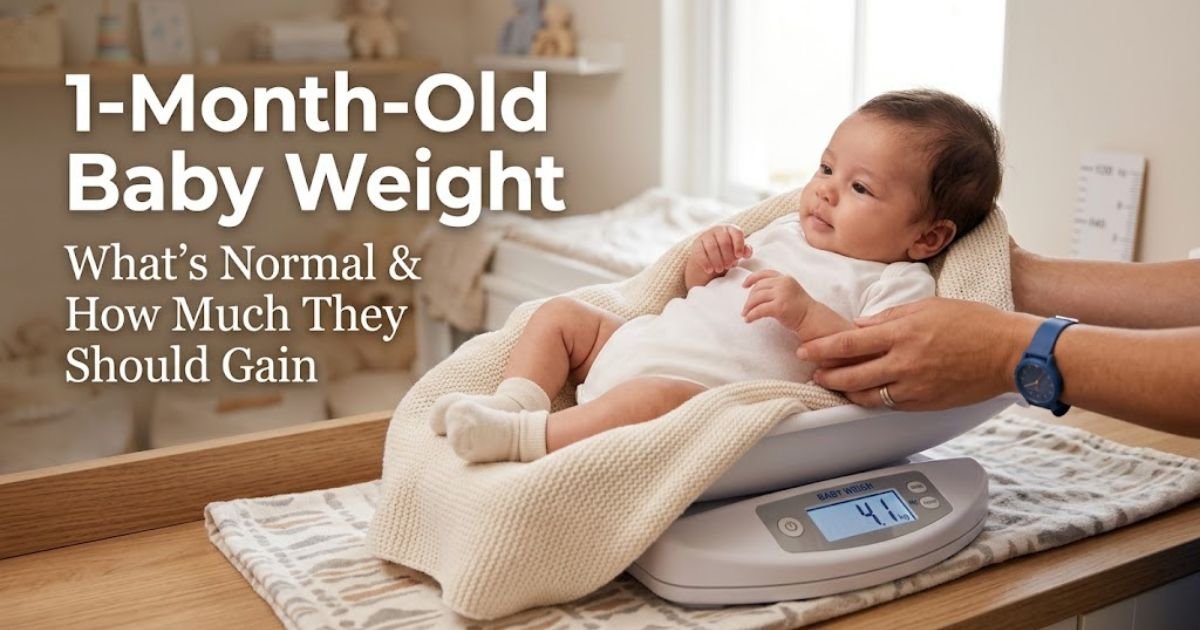
At 1 month, the average baby weighs 4.2–4.5 kg (9.2–9.9 lbs), with boys slightly heavier than girls. Most babies gain 150–200g per week at this stage. Weight varies widely based on birth weight, feeding method, and genetics. What matters most is steady growth along your baby’s own percentile line, not hitting a specific number.
What’s the Average 1-Month-Old Baby Weight?
Let’s start with the numbers, because that’s what you probably came here to find.
According to the CDC and World Health Organization (WHO), here’s what healthy 1-month-old babies typically weigh:
Male babies (1 month): 4.4–4.5 kg (9.7–9.9 lbs) 50th percentile
Female babies (1 month): 4.1–4.2 kg (9.0–9.3 lbs) 50th percentile
But “average” doesn’t mean your baby has to hit that exact number. Babies at birth weigh anywhere from 2.5 to 4.0 kg, and that starting point matters a lot. A baby born at 3.9 kg will reasonably weigh more at 1 month than a baby born at 2.8 kg. They’re both healthy. They’re both normal.
Understanding the Full Range
The CDC and WHO track babies across percentiles essentially rankings that show how your baby’s weight compares to others the same age and sex. Here’s what “healthy” looks like:
| Percentile | Male Baby Weight | Female Baby Weight | What It Means |
| 3rd (lower end of normal) | 3.9 kg (8.6 lbs) | 3.7 kg (8.2 lbs) | Still healthy; bottom of normal range |
| 50th (median/average) | 4.4 kg (9.7 lbs) | 4.2 kg (9.2 lbs) | Right in the middle |
| 97th (upper end of normal) | 5.3 kg (11.7 lbs) | 5.0 kg (11.0 lbs) | Still healthy; top of normal range |
The golden rule: Any baby between the 3rd and 97th percentile is growing normally. If your pediatrician isn’t concerned, you shouldn’t be either.
How Birth Weight Matters
Here’s a reality check: where your baby started affects where they land at 1 month.
If your baby weighed 3.2 kg at birth (average), they’d likely weigh around 4.2 kg at 1 month close to the 50th percentile.
If your baby weighed 3.9 kg at birth (heavier than average), they might weigh 4.8 kg at 1 month closer to the 75th–90th percentile.
If your baby was born at 2.8 kg (lighter), they might weigh 3.8 kg at 1 month, maybe around the 25th percentile.
All three babies are gaining weight beautifully and at healthy rates. They just started at different places.
The First Week Reality: Normal Weight Loss
Here’s something that catches many parents off guard: babies often lose weight in the first few days after birth, and it’s completely normal.
Breastfed babies typically lose 5–7% of birth weight in the first week.
Formula-fed babies typically lose 3–5% of birth weight in the first week.
Why? Not because anything is wrong, but because of fluid loss. Your baby is adjusting to the world outside the womb they’re clearing excess fluid, and their stomach is tiny, so they’re taking small feeds.
By day 10–14, most babies regain their birth weight. By week 3–4, they’ve moved well past it and are gaining steadily.
If your baby lost more than 10% or hasn’t regained birth weight by 3 weeks, your pediatrician will monitor more closely but this is rare and usually catches up quickly.
Read More: Caption for Baby Girl Sweet & Adorable Ideas for Instagram
How Much Weight Should Your 1-Month-Old Gain Per Week?
The big picture of weight gain at 1 month isn’t about one moment in time, it’s about trajectory. Is your baby moving steadily upward?
Expected Weekly Gain at 1 Month
At this stage, healthy babies typically gain 150–200 grams (5–7 ounces) per week.
Here’s what that looks like across the month:
- Week 1 (post-birth): Likely losing weight (normal) or flat
- Week 2: Starting to gain (150–200g)
- Week 3: Continuing to gain (150–200g)
- Week 4: Continuing to gain (150–200g)
So if your baby was 3.5 kg at birth and lost 5% in week 1, they’d be around 3.3 kg by day 7. By week 4 (one month), they’d be around 4.2 kg a gain of roughly 600–700g from the lowest point.
Why Breastfed Babies Gain Differently Than Formula-Fed Babies
Here’s an important distinction that doesn’t get enough attention: breastfed and formula-fed babies don’t gain weight at the same rate at 1 month.
Breastfed babies at 1 month average about 150–180g per week.
Formula-fed babies at 1 month average about 180–220g per week.
This means formula-fed babies are often noticeably heavier by 1 month, sometimes 200–400g more.
This isn’t because breast milk is inadequate. It’s because:
- Breast milk composition changes it’s higher in lactose and nutrients that optimize growth, not maximum weight gain
- Feeding frequency differs breastfed babies feed 8–12 times a day on smaller volumes; formula-fed babies feed fewer times on larger, measured amounts
- Caloric density formula is standardized and consistent; breast milk adjusts to your baby’s needs
- WHO standards account for this the growth charts you’re using already expect breastfed babies to be slightly lighter, and that’s fine
Bottom line: If your breastfed baby weighs 100–150g less than a formula-fed baby of the same age, that’s expected and healthy. Your pediatrician knows this.
Growth Isn’t Linear
One more reality: not every week will show exactly 150–200g gain.
Some weeks, your baby gains 250g. Some weeks, 100g. Some weeks feel flat. That’s normal. What matters is the trend over 2–4 weeks, not week-to-week fluctuation.
Understanding Baby Weight Percentiles: What It Really Means
Okay, let’s tackle the number one source of parent confusion: percentiles.
When your pediatrician says, “Your baby is at the 40th percentile,” what they’re actually saying is: “Out of 100 healthy babies the same age and sex, 40 of them weigh less than yours, and 60 weigh more.”
It is NOT a grade. It’s a rank.
The Percentile Breakdown
- 3rd–25th percentile: Below average weight, but fully normal and healthy
- 25th–75th percentile: Average range (middle 50% of babies)
- 75th–97th percentile: Above average weight, but fully normal and healthy
- Below 3rd or above 97th: Warrants pediatrician discussion (not necessarily a problem, but worth monitoring)
Your baby can be anywhere from the 3rd to the 97th percentile and be perfectly, completely healthy.
What Actually Matters: Trajectory, Not the Number
Here’s the secret pediatricians care about: Is your baby staying on their own growth line?
If your baby was at the 30th percentile at birth and the 30th percentile at 1 month, they’re growing exactly as expected. Growth is consistent.
If your baby was at the 50th percentile at birth and dropped to the 10th percentile at 1 month, that’s a red flag worth discussing not because the 10th percentile is inherently bad, but because the baby shifted dramatically.
If your baby was at the 15th percentile at birth and climbed to the 50th percentile at 1 month, that’s a growth spurt (common) and still totally fine.
The percentile is just a snapshot. The trajectory is the story.
Why Do Breastfed Babies Weigh Less Than Formula-Fed Babies at 1 Month?
This deserves its own section because it worries so many parents.
The Data
On average, breastfed babies weigh 100–150g (3–5 oz) less than formula-fed babies at 1 month. Some studies show differences up to 200g.
This is consistent across CDC, WHO, and international pediatric data. It’s real. It’s measurable. And it’s completely normal.
Why the Difference Exists
1. Milk Composition Matters
Breast milk contains different proportions of nutrients than infant formula:
- Breast milk is higher in lactose (milk sugar) and certain growth-supporting proteins
- This promotes lean, sustained growth rather than rapid weight gain
- Formula is higher in total calories, which translates to faster weight gain
2. Feeding Pattern Differences
- Breastfed babies typically feed 8–12 times per day on variable amounts (10–50 ml per feed)
- Formula-fed babies typically feed 6–8 times per day on consistent amounts (60–100+ ml per feed)
- Larger, more frequent measured volumes = more calories overall = faster weight gain
3. Supply-and-Demand Adjustment
- Breast milk adjusts to your baby’s actual needs over time
- Formula is one-size-fits-all (though you can adjust portions, you typically follow package guidelines)
The Reassurance You Need
This weight difference is not a sign of inadequate feeding. The WHO, CDC, and American Academy of Pediatrics all account for this in their growth charts. When pediatricians use WHO charts (which the CDC recommends for all US babies under 2 years), they’re expecting breastfed babies to track slightly below formula-fed babies. Both patterns are normal.
If your breastfed baby is tracking steadily along their percentile line and your pediatrician isn’t concerned, your baby is absolutely getting enough milk.
Your 1-Month-Old’s Weight & Feeding: Is It a Sign They’re Eating Enough?
Weight gain is one proxy for feeding adequacy, but it’s not the only one. Let’s be clear about what weight does and doesn’t tell you.
Weight Gain = Good Sign of Adequate Feeding
If your baby is gaining 150–200g per week at 1 month and feeding well, they’re definitely getting enough.
But Weight Alone Doesn’t Tell the Whole Story
Breastfed babies: Don’t rely on weight alone. Also look for:
- 8–12 wet diapers per day (by day 5–7)
- 6–8+ dirty diapers per day (often one after most feeds)
- Baby comes off the breast satisfied (relaxed, drowsy, hands open)
- You hear swallowing during feeds
- Breasts feel softer after feeds (milk has been removed)
- Baby gains weight steadily (even if breastfed, so slightly slower)
Formula-fed babies: Look for:
- Wet diapers: 6+ per day by day 5–7
- Dirty diapers: 1–2+ per day (formula-fed babies poop less than breastfed babies; this is normal)
- Finishing bottles and seeming satisfied
- Steady weight gain (formula-fed babies often gain faster, which is expected)
- Following the feeding schedule without excessive fussiness
When Weight Gain Signals a Problem
If your baby’s weight gain stalls or reverses between 1-month visits, that’s when weight becomes a red flag. Possible reasons include:
- Breastfeeding latch issues tongue tie, positioning, insufficient milk transfer
- Feeding technique bottle propping, inconsistent schedule, not burping
- Milk supply concerns rare at 1 month but possible
- Medical issues reflux, tongue tie, food sensitivities, infection
- Medication or maternal factors some medications affect milk supply
If you see slow or stalled weight gain, ask your pediatrician immediately. Early intervention (lactation consultant, feeding assessment, medical evaluation) makes a huge difference.
Read More: 8 Months Old Baby Caption: 150+ Cute, Funny & Sweet Ideas
What If Your Baby Was Born Early? Understanding Corrected Age & Weight
If your baby was born before 37 weeks, their weight assessment works differently.
Corrected Age Explained
Corrected age (also called adjusted age) = chronological age minus the number of weeks they were born early.
Example: Baby born 8 weeks early, now 4 months old chronologically = 2 months corrected age.
For the first 2 years of life, you compare a preterm baby’s weight to charts using their corrected age, not their birth date age. This gives a fair comparison to other healthy babies.
Why This Matters
Preterm babies catch up to term babies during the first year. If you plotted a 4-month-old who was 8 weeks premature on standard 1-month weight charts, you’d think they were small. But on 2-month charts (corrected age), they’d look right on track.
Which Charts to Use
- First 2 years (or until caught up): Use corrected age with WHO or CDC charts
- After age 2: Switch to chronological age
- Alternative option: Some pediatricians use Olsen or Fenton preterm-specific growth curves for the very early weeks (first 50 days), then transition to WHO
Your pediatrician will guide you on this. They’ll either do the correction automatically or tell you which age to use when tracking growth at home.
Read More: 1 Month-Old Baby Feeding Schedule How Much, How Often & What to Expect
When Should You Be Concerned About Your 1-Month-Old’s Weight? Red Flags
Let’s get specific about when weight is actually a worry and when it’s not.
Green Light (Not Concerning)
Baby is between the 3rd–97th percentile
Baby’s weight is consistent with birth weight starting point
Baby is gaining 100–250g per week (even if not exactly 150–200g)
Baby’s percentile is flat or slightly rising (trajectory is steady)
Breastfed baby weighs slightly less than formula-fed peers
Baby regained birth weight by week 2–3
Pediatrician says weight looks good
Action: Keep attending well-baby visits. Trust your pediatrician.
Yellow Light (Worth Discussing at Next Visit)
Baby’s weight is between 1st–3rd percentile (low, but not alarming; still worth monitoring)
Baby gained less than 100g in a week (occasional is fine; persistent is worth asking about)
Baby lost weight after the first week (rare; ask pediatrician)
Weight gain feels slow compared to siblings or friends (remember: feeding method, genetics, and percentile matter)
Action: Mention at your 1-month or 2-month visit. Bring notes on feeding and any concerns.
Red Light (Call Pediatrician Soon)
Baby’s weight is below 1st percentile (or below 3rd percentile consistently across 2+ visits)
Baby’s percentile dropped 2+ major lines between visits (e.g., from 50th to 10th)
Baby failed to regain birth weight by 3 weeks
Baby lost weight after the first week and isn’t recovering quickly
Baby is feeding poorly (weak suck, falling asleep at breast/bottle, not finishing feeds)
Diaper output is low (fewer wet/dirty diapers than expected)
Baby seems lethargic or unwell
Action: Call your pediatrician today or tomorrow. Don’t wait for the next scheduled visit.
Medical Conditions That Can Slow Weight Gain
If weight gain stalls, your pediatrician might explore:
- Tongue tie restricts milk transfer; breastfeeding feels difficult
- Reflux baby spits up frequently; seems uncomfortable after feeds
- Allergies or sensitivities cow’s milk protein allergy (most common), food sensitivities
- Feeding technique issues latch problems, bottle propping, inconsistent schedule
- Infection UTI, thrush, other infections reduce appetite
- Maternal milk supply rare at 1 month but possible with certain medications or conditions
None of these are catastrophes. Early detection and intervention (lactation consultant, pediatric GI specialist, feeding assessment) fix most issues quickly.
Read More: Baby Captions for Instagram Sweet & Adorable Ideas
How Often Should Your 1-Month-Old Be Weighed?
Here’s the practical question: Do you need a baby scale at home?
Professional Weighing Schedule
First 2 weeks of life:
- Hospital before discharge
- Home visit (day 3–5)
- 2-week pediatric checkup
After 2 weeks:
- 1-month visit (around 4 weeks)
- 2-month visit (around 8 weeks)
- 4-month, 6-month, 9-month, 12-month visits
- Then annual visits (or as needed)
Home Weighing: Is It Necessary?
You do NOT need a baby scale at home unless your pediatrician asks you to monitor weight between visits (e.g., if there’s a concern or breastfeeding issue).
If you choose to weigh at home:
- Do it 1–2 times per week maximum (not daily)
- Weigh same time of day for consistency
- Weigh naked (diaper adds 100–150g and throws off comparisons)
- Use the same scale each time
- Track over 4 weeks, not day-to-day (daily fluctuations are normal ±200g)
Why not weigh daily? Daily weight fluctuates due to feeding, hydration, diaper output, and bowel movements. You’ll see gains and losses that mean nothing, and you’ll panic over phantom problems. It feeds parental anxiety without providing useful data.
The Better Use of Your Brain Space
Instead of obsessing over weight numbers, focus on:
- Is your baby feeding well? (latch feels good, swallowing, coming away satisfied)
- Is your baby’s diaper output normal? (wet and dirty diapers on track)
- Does your baby seem content? (alert, responsive, not excessively fussy)
- What does your pediatrician say? (trust their assessment; they see dozens of babies weekly)
Your pediatrician will weigh your baby at every visit and let you know if anything is off. That’s their job. Your job is to feed your baby, love your baby, and get enough sleep (ha).
Conclusion
Your 1-month-old’s average weight is 4.2–4.5 kg (9.2–9.9 lbs), but what matters most is steady growth along your baby’s percentile line, not hitting a specific number.
Breastfed babies may weigh slightly less than formula-fed peers; both are normal. Babies born premature need corrected-age calculations. Weight gain of 150–200g per week is healthy at this stage. If your pediatrician isn’t concerned, trust that. Track weight at scheduled visits; don’t obsess at home. If you see rapid drops, feeding difficulties, or health concerns, reach out to your doctor for early intervention.
FAQs
Is 4 kg normal for a 1-month-old?
Yes, absolutely. The average is 4.2–4.5 kg, so 4.0 kg is on the lower end of normal but completely healthy. What matters is whether your baby is following their own percentile line and your pediatrician is happy. Some babies are meant to be smaller.
How much weight do babies lose after birth?
Breastfed babies typically lose 5–7% of birth weight; formula-fed babies lose 3–5%. This is normal. Most regain birth weight by day 10–14 and are back on track by week 3. If your baby lost more than 10% or hasn’t regained by 3 weeks, tell your pediatrician.
Why does my breastfed baby weigh less than my friend’s formula-fed baby?
Breastfed babies are usually 100–150g lighter at 1 month than formula-fed babies. This is because breast milk promotes lean growth, not maximum weight gain. Both are normal. WHO and CDC growth charts account for this difference.
What if my baby isn’t gaining weight?
Weight gain is considered adequate at 1 month if it’s 100g+ per week. If gain is slower or stalled, discuss with your pediatrician. Possible causes: latch issues, low milk supply (breastfed), feeding technique (formula-fed), medical issues, or tongue tie. Early intervention fixes most problems.
Will my baby triple their birth weight by 1 year?
Most babies do, yes. Babies typically double their birth weight by 4–6 months and triple it by 12 months. But this varies. Some babies are naturally smaller and will triple a lighter birth weight. Your pediatrician tracks this, not you.
Do growth spurts happen in 1 month?
Minor fluctuations happen, but major growth spurts typically occur around 3 weeks, 3 months, and 6 months. At 1 month, growth is usually steady and predictable.
Should I worry if my baby is at the 10th percentile?
No. The 10th percentile is fully within the normal range. Any baby from 3rd to 97th percentile is healthy. What matters is the trajectory of your baby staying on their line?
