

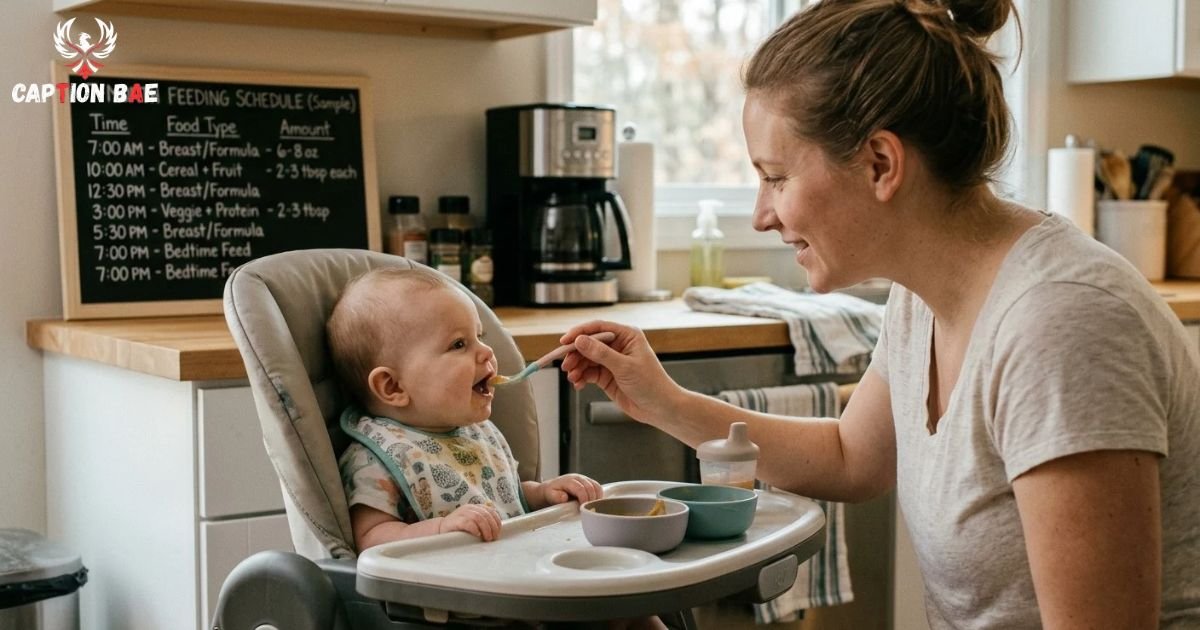
A 7-month-old typically drinks 24–32 ounces of breast milk or formula per day and eats 1–2 solid meals. Milk is still the main source of nutrition. Solids are mostly practice for now. Solid Starts, whose pediatricians and feeding specialists review its schedules, recommends keeping milk feeds primary in the first year.
Sample 7-Month-Old Feeding Schedule (Formula-Fed)
This is an example, not a rule. Real babies shift daily. It blends the patterns in the Huckleberry and Solid Starts schedules.
| Time | What happens |
| 6:30 AM | Wake up, bottle |
| 7:30 AM | Solid meal #1 (breakfast) |
| 9:00 AM | Nap |
| 10:30 AM | Bottle |
| 12:30 PM | Bottle, or a solid meal on days you offer two lunches’ worth |
| 1:00 PM | Nap |
| 3:00 PM | Bottle |
| 5:00 PM | Solid meal #2 (early dinner) |
| 5:45 PM | Top-off bottle if baby is still hungry |
| 6:30 PM | Bedtime bottle, then bed |
| Night | Optional feed only if baby needs one |
Nap note: Around this age babies are usually awake about 2–2.5 hours at a time and take about three naps a day, according to Solid Starts. Try to finish a top-off bottle at least 30 minutes before a nap so baby doesn’t fall asleep on the bottle.
Breastfed, On-Demand Version
If you nurse on demand, you don’t need clock times. Solid Starts describes 8 or more breastfeeds a day at 6–7 months, with 1–2 solid meals. Many babies nurse 8–12 times a day, and that’s fine if baby is growing well.
A simple pattern:
- Nurse when baby wakes up.
- Wait about an hour, then offer solids at the table.
- Nurse again as a “top-off” if baby is still hungry.
- Repeat for the second meal on days you offer two.
Combo-Fed Version
If you use both breast and bottle, follow the bottle schedule above as a rough guide, per Solid Starts.
Read More: 6 Month Old Feeding Schedule: Sample Day, Amounts & Foods
How Much Should a 7-Month-Old Eat?
Milk: 24–32 Ounces a Day
The U.S. sources agree on the daily total. NJ WIC says babies need about 24–32 oz of iron-fortified formula a day. Huckleberry gives the same range.
Sources disagree on how many feeds that comes from. That’s where parents get confused.
The Feed-Math Check
Here’s a simple way to test any schedule. It’s plain arithmetic, so you can use it on any chart you find online.
Daily ounces ÷ number of feeds = ounces per feed
| Feeds per day | Ounces per feed (24–32 oz total) |
| 4 | 6–8 oz |
| 5 | About 5–6.5 oz |
| 6 | About 4–5.3 oz |
| 8 | 3–4 oz |
Use it as a sanity check. If a chart says “6–8 oz per feed, 6 feeds a day,” that’s 36–48 oz, well above the usual range. More small feeds or fewer big ones can both be normal, as long as the daily total is in range and baby is growing.
Remember: Some babies drink more during growth spurts and some drink less. Solid Starts says that if a baby is growing well and having plenty of wet and dirty diapers, they’re likely getting what they need.
Solids: A Few Tablespoons
At this age, solids are for learning, not filling up. Solid Starts says the first meals are mainly practice, so don’t worry much about how much baby swallows.
For a rough idea of portions, NJ WIC (written for 6–7 month olds) suggests these daily amounts:
| Food group | Daily amount |
| Iron-fortified infant cereal | 2–4 Tbsp, up to twice a day |
| Vegetables | 4–8 Tbsp |
| Fruit | 2–4 Tbsp |
| Protein (meat, egg, fish, legumes) | 2–4 Tbsp |
These are guides, not targets. If baby eats one spoonful and plays with the rest, that still counts as a meal.
Should Milk Come Before or After Solids?
Both approaches exist, and they come from different countries.
- Milk first (common in the U.S.): Solid Starts suggests offering milk about 30 minutes before a meal so baby isn’t too hungry to focus. Huckleberry suggests a gap of 30–60 minutes between a milk feed and solids.
- Solids first (NHS, UK): The NHS says baby’s tummy is small and fills quickly, so offer milk after solids.
A simple rule: If baby is frantic and cries at the high chair, give a small milk feed first. If baby is calm but ignores food, try solids first and offer milk afterward. Either way, keep milk feeds going. Don’t let solids replace them.
Read More: 7-Month-Old Baby Milestones Physical, Cognitive, Social & What’s Normal
Is My Baby Eating Enough?
Ounces alone can mislead you. Look at the whole picture:
- Growth: Baby is following their curve at checkups.
- Diapers: Wet and dirty diapers look normal for your baby.
- Mood: Baby is generally content between feeds.
- Cues: Baby opens wide for the spoon, or turns away and closes their mouth when done.
If you see a big drop in milk intake, Solid Starts suggests scaling back solids, since they may be filling baby up too much. If you have concerns about weight or wet diapers, call your pediatrician.
What to Feed: Iron and Allergens
Iron-Rich Foods
Iron matters a lot at this age. The NHS stresses offering a wide variety of foods to get enough energy and nutrients such as iron. Good options listed by Similac and the NHS include:
- Iron-fortified baby cereal (oat, barley, rice)
- Well-cooked, pureed or mashed meat, poultry, and fish (no bones)
- Beans, lentils, chickpeas, and tofu
- Eggs
Common Allergens
Introduce new foods one at a time so you can spot a reaction. Similac advises contacting your baby’s healthcare provider right away if you suspect a reaction, and calling 911 for a severe one. Signs listed by HealthHub include facial swelling, rashes, vomiting, diarrhea, and trouble breathing.
Talk to your pediatrician before offering peanut, egg, or fish if your baby has eczema or a known food allergy. (Editor note: verify current AAP/NIAID allergen-timing guidance before publishing and link to it.)
Read More: 1-Month-Old Baby Coughing But No Fever? What Parents Need to Know
Safety: Gagging, Choking, and Foods to Skip
Gagging is loud and messy. Baby coughs, sputters, and often recovers on their own. Choking is quiet. Baby can’t cough, cry, or breathe, and you need to act immediately. Learn infant CPR before you start finger foods.
Foods and drinks to avoid:
- Cow’s milk as a drink until 12 months (small amounts in cooking are fine, per the NHS)
- Honey under 12 months
- Added salt or sugar. The NHS notes babies don’t need either
- Sugary drinks and juice
- Whole nuts and hard, round, or slippery chunks that can block the airway
Pouches: The NHS says pouches are fine now and then but shouldn’t be an everyday food. Squeeze the contents onto a spoon rather than letting baby suck from the pouch.
Water, Cups, and Night Feeds
Water
Milk covers hydration. Small sips help baby learn to use a cup. Solid Starts suggests under 2 oz per meal and no more than 4 oz a day unless your pediatrician says otherwise. Try an open cup and a straw cup, alternating at meals.
Night Feeds
You don’t have to wake a sleeping baby to feed. Huckleberry says many 7–8 month olds can sleep long stretches, though some do better with a dream feed or an early-morning feed around 3–5 AM.
If baby is nursing a lot at night, they may be less hungry for breakfast. Solid Starts notes that heavy night feeding can dampen daytime appetite for solids. If you want to shift things, talk to your pediatrician first.
Snacks
Babies under 12 months don’t need snacks, according to the NHS. If baby seems hungry between meals, offer extra milk.
Sample Meal Ideas
Breakfast: Iron-fortified oatmeal with mashed banana or pureed pear
Lunch: Mashed sweet potato with shredded chicken or mashed lentils
Dinner: Soft-cooked broccoli or cauliflower with flaked salmon (no bones) and a little rice or oatmeal
Purees, finger foods, or both? All work. The NHS says there’s no right or wrong way, and many families combine them. As baby gets better at chewing, offer thicker mashes and soft finger foods.
A Note on Real-Life Flexibility
Skip a meal when baby is tired or sick. Move the meal earlier or later when your day changes. Solid Starts is clear that rigid timing matters less than regular chances to practice eating with the family.
If your baby was born early, has a medical condition, or isn’t growing as expected, ask your pediatrician for a plan that fits them. Ask about corrected age for preemies.
Conclusion
At 7 months, a consistent feeding timetable can help your baby get used to different foods while continuing to receive the nutrition they need from breast milk or formula. Focus on age-appropriate textures, a variety of nutritious foods, and responsive feeding based on your baby’s hunger and fullness cues. Every baby develops differently, so adjust portions and timing as needed and consult your pediatrician if you have concerns about feeding or growth.
FAQs
How many times a day should a 7-month-old eat?
Most 7-month-olds have 4–6 milk feeds (or 8+ nursing sessions) and 1–2 solid meals. Feed frequency varies, so focus on the daily total and how baby is growing.
Is 4 feeds a day enough for a 7-month-old?
It can be. At 4 feeds, each bottle would need to be about 6–8 oz to reach 24–32 oz. Huckleberry says 4 feeds may be enough, especially with solid meals. Check with your pediatrician if baby seems unsatisfied.
Is 30 ounces too much for a 7-month-old?
No. Thirty ounces falls within the usual 24–32 oz range cited by Huckleberry, Solid Starts, and NJ WIC.
Can a 7-month-old eat three meals a day?
Some do, and that can be fine if baby still gets their full milk intake. Solid Starts recommends 1–2 meals at this age, moving toward 3 by around 10–11 months.
My baby refuses solids. What should I do?
Stay calm and keep offering. The NHS says it can take 10 tries or more for a baby to accept new foods. Offer solids when baby is rested and mildly hungry, and don’t force it.
Should I still wake my baby for night feeds?
No, not unless your pediatrician has told you to. Huckleberry says there’s no need to wake a baby to feed at this age.
Can a 7-month-old drink water?
Yes, in small amounts with meals. Solid Starts suggests less than 2 oz per meal and no more than 4 oz per day.
