

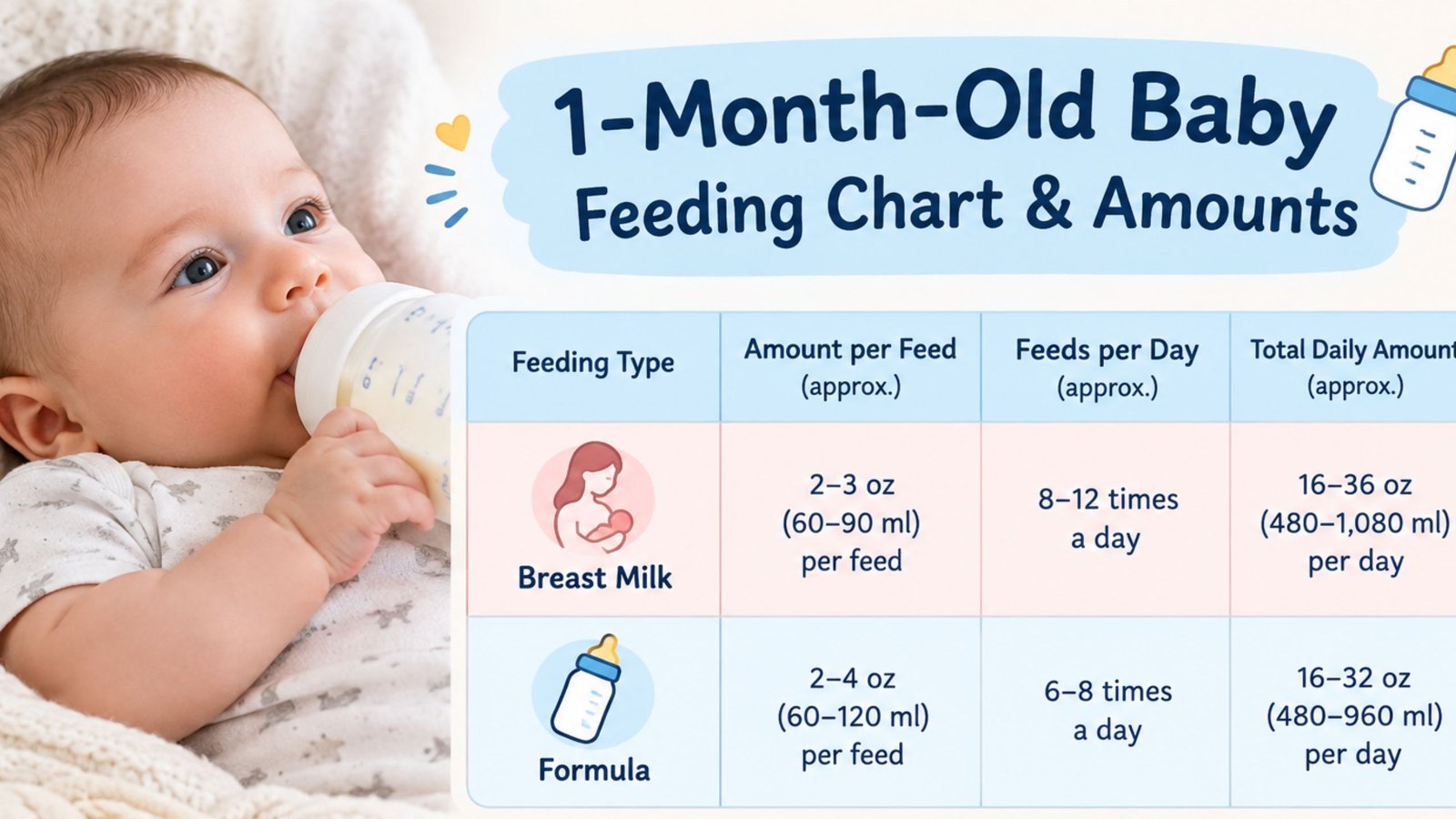
A 1-month-old typically drinks 2–3 ounces per feeding, 8–12 times daily. That’s roughly 16–24 ounces (480–720 mL) per day, though every baby is different. The real signs your baby is getting enough: 5–6 wet diapers, 1–4 normal stools, and steady weight gain of 0.5 — 1 ounce per day. If your pediatrician says your baby is gaining weight and passing the wet diaper test, you’re doing fine.
How Much Formula Should a 1-Month-Old Eat? (The Numbers)
The American Academy of Pediatrics (AAP) recommends feeding your newborn 2.5 milliliters per pound of body weight per day. Let’s make that real.
Here’s the math: If your baby weighs 7 pounds, multiply 7 × 2.5 = 17.5 ounces total per day. Spread that across 8 feedings, and you get roughly 2.2 ounces per feeding. If your baby weighs 8 pounds, aim for about 2.5–3 ounces per feeding.
This is your starting point, not a rule. Newborns don’t read guidelines. Some babies wolf down 3 ounces at every sitting; others are satisfied with 2. Your job is to offer, watch, and adjust. Babies are excellent at self-regulation they’ll eat more on growth spurt days and less on sleepy days.
Note: Premature babies and those with lower birth weights may need adjustments. Ask your pediatrician for a target tailored to your baby’s size and health.
Read More: 1-Month Old Baby Constipation What’s Normal, What’s Not & How to Help
Week-by-Week Feeding Chart (First Month)
Use this chart as a reference. Your baby may eat slightly more or less that’s normal.
| Week | Ounces per Feeding | Feeding Frequency | Total per Day | Notes |
| Week 1 | 1–2 oz | 8–10 times | 8–15 oz | Transition period; stomach is tiny. Frequent feeding is normal. |
| Week 2 | 2 oz | 8–10 times | 16–20 oz | The baby’s appetite grows. Continue on-demand feeding. |
| Week 3 | 2–2.5 oz | 8–10 times | 16–25 oz | Some babies start spacing feeds slightly. I still eat frequently. |
| Week 4 | 2.5–3 oz | 8–12 times | 20–36 oz | Appetite increases noticeably. Some babies may cluster feed. |
What this chart means: Your baby’s stomach is only the size of a marble at birth and a walnut by week 2. That’s why frequent small feedings are normal and healthy, not a sign that something is wrong.
How to Know Your Baby Is Eating Enough
Forget obsessing over the exact ounces. Focus on these five measurable signs instead:
Wet Diapers: The Gold Standard
- By day 5 of life, your baby should have 5–6 wet diapers per day.
- This is the single best indicator of adequate feeding.
- Before day 5, the number gradually increases (1 wet diaper on day 1, 2 on day 2, etc.).
- If your baby isn’t hitting 5–6 by day 5, call your pediatrician.
Stools: Color and Frequency Matter
- By day 5, your baby’s stools should transition from black (meconium) to greenish-brown to mustard yellow or light brown.
- At 1 month, expect 1–4 bowel movements per day.
- Formula-fed babies may have slightly firmer, tan-colored stools that’s normal.
- Gray or pale stools, or hard pellets, can signal inadequate feeding. Mention this to your pediatrician.
Weight Gain: The Proof
- Your baby should regain birth weight by 10–14 days of life.
- From 2 weeks onward, expect 0.5–1 ounce of weight gain per day (or roughly 1 pound per month).
- Your pediatrician will check this at the 2-week and 1-month visits. These appointments are critical, don’t skip them.
Feeding Duration and Behavior
- Most babies spend 15–20 minutes per bottle or breastfeeding session.
- After feeding, your baby should look content and drowsy, not frantically searching for more food seconds later.
- Between feedings, your baby should have periods of alertness and calm. Constant fussiness might signal hunger, but it could also be gas, overstimulation, or just a fussy baby.
Overall Appearance
- Your baby’s face fills out slightly; cheeks puff up.
- Skin looks healthy and hydrated (not wrinkled or loose).
- Baby is alert during the day and sleeps in predictable stretches at night.
The bottom line: If you check these five boxes, your baby is eating enough. Period.
Read More: 5 Month Old Baby Captions: 100+ Cute, Sweet & Loving Instagram Ideas
Breastfeeding vs. Bottle Feeding: How Much Is Enough?
Breastfeeding: Trust the Process
You can’t see how much milk your baby is drinking and that drives many parents crazy. Resist the urge to weigh your baby before and after each feeding. That creates unnecessary anxiety.
Instead:
- Latch matters. Proper latch = efficient milk transfer. Ask a lactation consultant if you’re unsure.
- Feeding time: Most breastfed babies nurse for 15–20 minutes at one or both breasts.
- Baby-led feeding: Let your baby pull away when satisfied. Don’t remove the breast early.
- Frequency: Expect 8–12 feeds per day for 1 month. Cluster feeding (more frequent eating for a few hours, then longer sleep) is completely normal, especially around week 2–3.
If wet diapers, stools, and weight gain are on track, your milk supply is fine.
Bottle Feeding (Formula or Expressed Milk)
Amount per bottle: 2–3 ounces at 1 month. Use the weight-based calculation above as your starting point.
Paced bottle feeding: This matters more than the exact ounces. Paced feeding means:
- Hold the bottle horizontally or slightly tilted (not pointing straight down).
- Let your baby suck and pause naturally, don’t force continuous feeding.
- Burp halfway through and at the end to reduce gas.
- Stop when your baby shows signs of fullness (turning away, slowing sucks, closing mouth).
Overfeeding risk: It’s harder to overfeed a breastfed baby (they self-regulate), but bottle-fed babies can drink more than they need if you keep the bottle in their mouth. Respect their pace and stop cues.
Breastfeeding to Bottle Conversion
If you’re pumping or switching between breast and bottle, here’s the equivalency:
- One breastfed session ≈ 2–3 ounces of expressed milk or formula (at 1 month).
- If exclusively pumping, aim for 20–30 ounces per day total by the end of the first month.
- Pumping output varies widely among mothers. 20 oz might be perfect for your supply, while another mom produces 35. Both are normal.
Combination Feeding (Breast + Bottle)
- Breastfeed first when milk supply is highest.
- Offer a bottle of expressed milk or formula afterward if your baby seems unsatisfied.
- This prevents “nipple confusion” (a debated term, but many lactation consultants recommend breastfeeding first).
- Track total intake by counting wet diapers and weight gain, not by adding bottles to breastfeeds.
Read More:
Red Flags: When to Call Your Pediatrician
Some feeding concerns warrant immediate attention. Call your pediatrician if:
- Your baby loses more than 10% of birth weight or hasn’t regained it by 2 weeks.
- Your baby has fewer than 4–5 wet diapers by day 5 of life (or stops wetting diapers after a good start).
- Your baby only has hard, infrequent stools and no soft or yellow bowel movements by day 4–5.
- Your baby seems extremely drowsy or hard to wake for feedings.
- Your baby shows poor latch, tongue-tie symptoms, or painful feeding (breastfeeding).
- Your baby gags, chokes, or refuses bottles consistently.
- Your baby has projectile vomiting (forceful vomiting, not just small spit-up).
- Your baby’s skin looks jaundiced (yellowed) beyond day 5, or jaundice worsens after day 5.
- You simply feel something is off, even if you can’t name it.
Trust your gut. Pediatricians expect feeding questions; it’s a huge part of newborn care. Calling doesn’t make you paranoid; it makes you a good parent.
Conclusion
You don’t need perfect ounces, you need wet diapers, normal stools, steady weight gain, and a pediatrician you trust. Feed your baby when they’re hungry, watch the measurable signs, and call your doctor with questions. Newborn feeding is a learning curve. You’re doing better than you think.
FAQs
Why does my 1-month-old seem hungry all the time?
Growth spurts hit around week 2–3 and again at 6 weeks. During these spurts, your baby eats more frequently; this is called cluster feeding. It’s not a sign your milk supply is low or that formula isn’t enough. It’s your baby signaling they need more calories to fuel growth. Feed on demand during cluster feeding, then return to normal rhythm after 24–48 hours.
Can I overfeed a newborn?
Breastfed babies self-regulate brilliantly true overfeeding is rare. Bottle-fed babies can overeat if you keep pushing the bottle or feed too quickly (ignoring their pause cues). Watch for your baby’s natural stopping signals: turning away, slower sucks, mouth closure. Then put the bottle down. A full baby is a content baby, not necessarily one who drains every ounce.
How should I prepare and store formulas safely?
Use sterilized bottles (boil 5+ minutes, use a sterilizer, or run through the dishwasher’s hot cycle). Mix formula with water at the temperature your pediatrician recommends (usually room-temperature or slightly warm). Never use hot tap water (can contain lead). Store prepared bottles in the refrigerator for up to 24 hours; discard any leftover formula from a feeding after 2 hours at room temperature (1 hour if warmer).
What’s the difference between cluster feeding and overfeeding?
Cluster feeding = frequent, short feeds over a few hours (e.g., feeding at 5 PM, 5:30, 6 PM, then sleeping 4+ hours). The baby is gaining weight, has normal stools and wet diapers, and seems content afterward. Overfeeding = constant fussiness despite feeding, excessive spit-up, or bloating. Cluster feeding is healthy; overfeeding is rare in breastfed babies and should be addressed if you suspect it in bottle-fed babies.
When should I introduce solids to my 1-month-old?
Not yet. Most babies aren’t developmentally ready for solids until 4–6 months. Signs of readiness include sitting upright with minimal support, loss of the tongue-thrust reflex, and genuine interest in food. The AAP recommends exclusive breastfeeding or formula feeding for at least the first 4–6 months. Introducing solids too early increases the risk of choking and allergies.
How do I know if my baby has a feeding problem?
Watch for: poor latch, excessive spitting up, slow weight gain, fewer wet diapers than expected, extreme fussiness, or a baby who won’t wake to feed. If these persist despite feeding on demand, mention it at your next pediatrician visit. Most feeding concerns are fixable with small adjustments (paced feeding, position changes, lactation support, or formula changes).
