

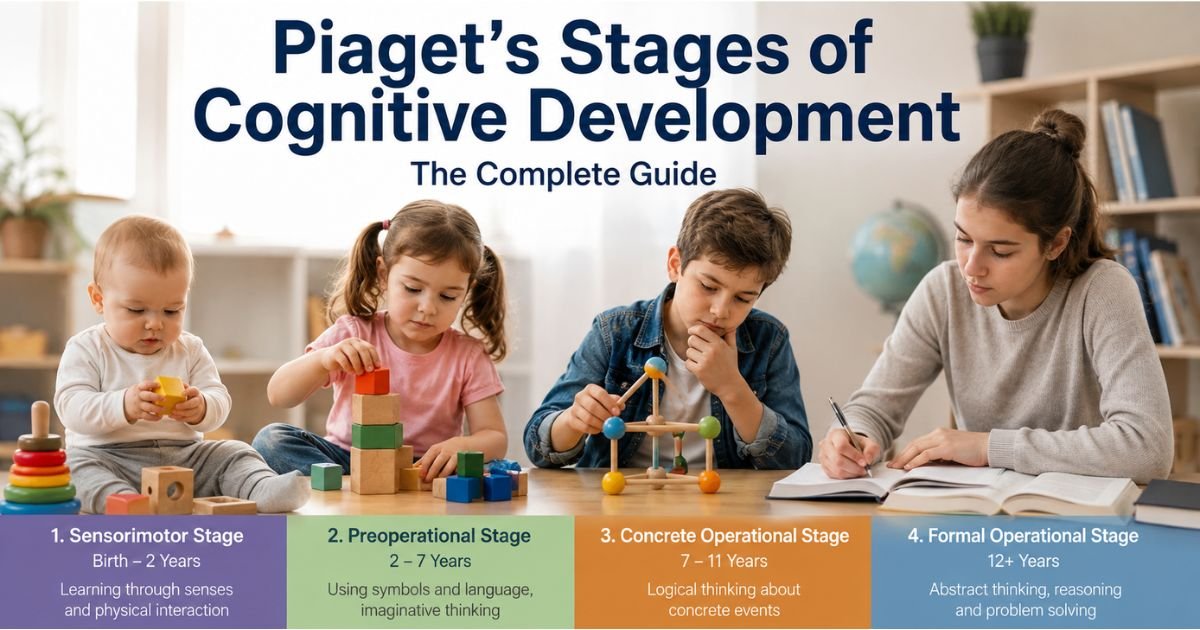
Piaget’s theory says all children move through four fixed stages of thinking: Sensorimotor (birth–2 years, learning through senses and action), Preoperational (2–7 years, symbolic thought but illogical), Concrete Operational (7–11 years, logical thinking about real things), and Formal Operational (11+ years, abstract and hypothetical reasoning). Every child passes through them in the same order though not everyone reaches the last one.
What Is Cognitive Development?
Cognitive development is how your ability to think, reason, remember, and solve problems changes as you grow from a newborn’s reflexes to an adult’s capacity for abstract logic.
Piaget’s big idea was that this isn’t just about kids “knowing more” as they age. It’s about their thinking working in a genuinely different way at each stage, not a smaller adult brain, but a different kind of brain altogether.
Piaget’s 4 Stages at a Glance
| Stage | Age Range | Core Ability |
| Sensorimotor | Birth – 2 years | Object permanence |
| Preoperational | 2 – 7 years | Symbolic (but illogical) thought |
| Concrete Operational | 7 – 11 years | Logical thought about real objects |
| Formal Operational | 11+ years | Abstract, hypothetical reasoning |
Piaget’s central rule: every child moves through these in this exact order. Nobody skips a stage, though children move through them at different speeds, and as we’ll get to not everyone reaches the final one.
Stage 1 Sensorimotor (Birth–2 Years)
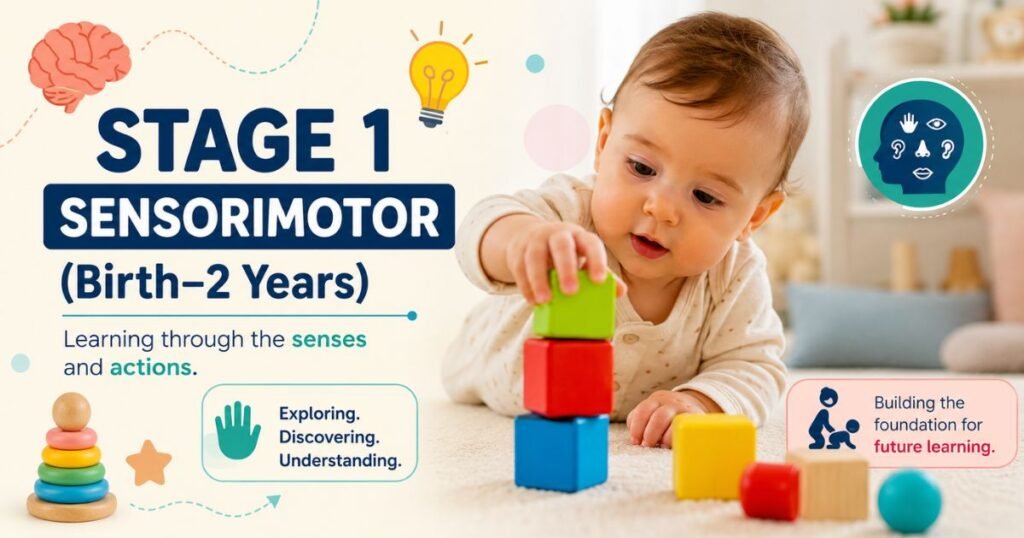
In this stage, a baby “thinks” almost entirely through their senses and physical movements touching, sucking, grasping, looking. There’s no real internal thought yet; there’s just action.
Age-by-Age Milestones
- Birth–2 months: Reflexive behaviors dominate sucking, grasping. A hidden object simply ceases to exist for the baby.
- 2–6 months: The infant starts repeating actions that felt good (shaking a rattle again and again), building an early sense of cause and effect.
- 6–12 months: Object permanence begins to emerge. A 6-month-old will look for a partially hidden toy, and by 9 months will search for one that’s fully hidden.
- 12–18 months: Walking and grasping open up active experimentation; the baby starts trying new ways to solve simple problems.
- 18–24 months: Full object permanence is typically in place, along with the first signs of pretend play using a block to “be” a car.
What Is Object Permanence?
Object permanence is the understanding that objects continue to exist even when they’re out of sight. Before this develops, an infant acts as if a hidden toy has vanished from reality; afterward, they’ll actively search for it, showing they’ve formed a mental representation of the object that persists in their mind.
Stage 2 Preoperational (2–7 Years)
Once toddlers learn language and symbols, their world explodes with imagination but their logic hasn’t caught up yet.
Egocentrism and Centration Explained
Egocentrism is a young child’s difficulty imagining that other people see the world differently than they do famously shown in Piaget’s “Three Mountains” experiment, where children struggled to describe what a doll on the other side of a model mountain would see.
Centration is focusing on just one feature of a situation while ignoring everything else. This is the mechanism behind the “taller glass has more juice” mistake: the child fixates on height and ignores width entirely.
Signs Your Child Is in This Stage
- Uses pretend play (talking to stuffed animals, “cooking” with toy food)
- Struggles to see a situation from someone else’s point of view
- Believes non-living things (the sun, a toy) have feelings a trait called animism
- Can’t yet reliably solve conservation tasks (see Stage 3)
Stage 3 Concrete Operational (7–11 Years)
Around age 7, something clicks: children start applying logical rules to real, physical things though abstract ideas are still out of reach.
What Is Conservation?
Conservation is the understanding that a quantity stays the same even when its appearance changes. For example, knowing that water poured from a short, wide glass into a tall, thin one is still the same amount. Children typically master this in a fixed order: number first (around age 6), then liquid and length, then weight, with volume being the last, usually mastered around age 11–12.
This stage also brings reversibility, the ability to mentally “undo” an action, like imagining a flattened ball of clay rolled back into a sphere and seriation, the ability to arrange objects in a logical order (smallest to largest, lightest to heaviest).
Stage 4 Formal Operational (11+ Years)
This final stage brings the ability to reason about things that aren’t physically present, hypotheticals, abstractions, and “what if” scenarios.
Adolescents in this stage can debate ethics, grasp algebra without needing physical objects to count, and systematically test a hypothesis rather than relying on trial and error.
Can Adults Get “Stuck” in an Earlier Stage?
Not exactly “stuck,” but formal operational thinking is not guaranteed. Research has found that a substantial share of college students and adults fail standard tests of formal operational reasoning, and some researchers estimate only a minority of adults consistently apply it across all areas of life. It’s also domain-specific: someone might reason abstractly about their job but think very concretely about an unfamiliar topic, like personal finance or a new hobby.
How Piaget’s Theory Compares Vygotsky, Erikson & Bronfenbrenner
| Theorist | Focus | Key Difference from Piaget |
| Lev Vygotsky | Social/cultural learning | Believed learning happens through social interaction and language first, not independent discovery; introduced the “Zone of Proximal Development” the gap between what a child can do alone versus with guidance |
| Erik Erikson | Psychosocial identity | Focused on emotional/identity conflicts across the whole lifespan (8 stages, infancy to old age), not just childhood cognition |
| Urie Bronfenbrenner | Ecological systems | Argued development is shaped by nested environmental systems (family, school, culture) rather than internal cognitive stages alone |
The throughline: Piaget saw the child as a “lone scientist” constructing knowledge through independent exploration. Vygotsky, Erikson, and Bronfenbrenner all pushed back, in different ways, on how much weight Piaget gave to social and cultural context.
Criticisms and Weaknesses of Piaget’s Theory
Piaget’s framework reshaped child psychology, but decades of follow-up research have exposed real cracks:
- The repeated-question problem. Piaget’s classic conservation task asks a child the same question twice before and after a transformation. Later researchers found that when the change was made to look accidental (a puppet “messing up” the objects, rather than the adult deliberately rearranging them), most 4- to 6-year-olds who’d failed the standard task suddenly answered correctly. A separate study of over 250 children found the same pattern kids did worst when asked twice and best when asked only once, suggesting the test itself, not just the child’s thinking, was producing the “wrong” answers.
- Small, non-representative samples. Piaget largely studied his own three children and other Western, relatively affluent kids, a narrow base for a universal theory.
- Underestimating infants. Piaget judged object permanence by whether a baby physically searched for a hidden object. Later studies using eye-tracking found infants as young as 4 months looked longer at objects behaving “impossibly,” suggesting some sense of object permanence existed well before Piaget’s estimated age the babies understood more than they could physically demonstrate.
- Cultural bias. A study of 8–14-year-old Indigenous Australian children in remote desert regions found conservation skills emerged later (around ages 10–13) than in Piaget’s original Swiss sample but spatial awareness, critical for navigating vast outdoor terrain, developed earlier. Cognitive development, it turns out, is shaped by what a culture actually demands of its children, not biology alone.
- Rigid stages vs. continuous growth. Vygotsky and later researchers argue development is more of a gradual continuum than a staircase with sharp steps.
What Modern Neuroscience Says
Brain-imaging research has started connecting Piaget’s behavioral observations to what’s physically happening inside the developing brain:
- Concrete operational stage (~age 7): fMRI studies show a parieto-frontal network activating when a child successfully completes a conservation task the parietal lobe handling spatial judgment (“how much water is in that glass?”) and the frontal lobe applying the logical rule (“nothing was added or removed”). Before age 7, these regions don’t communicate as efficiently.
- Formal operational stage (adolescence): the brain undergoes major “renovation” through neural pruning (clearing unused connections) and myelination (coating neural pathways to speed up signals) concentrated heavily in the prefrontal cortex, the region behind abstract thinking, planning, and weighing hypothetical scenarios.
- Executive function: as the cortex thickens through childhood, working memory expands giving kids more mental “RAM” to hold complex ideas in mind at once, which tracks closely with their ability to perform Piagetian tasks.
None of this proves Piaget was exactly right about timing but it does show his stage transitions line up with real, measurable changes in brain wiring.
The “SOFA” Framework A Memory Trick for the 4 Stages
Here’s a simple way to lock in the order: S-O-F-A.
- Senses (Sensorimotor learning through senses and action)
- Objects/symbols (Preoperational using symbols, but still illogical)
- Facts (Concrete Operational logical thinking about real, concrete facts)
- Abstraction (Formal Operational abstract, hypothetical reasoning)
Each letter also matches the age order of a child moving from their senses, to objects they can name and pretend with, to facts they can reason about logically, and finally to full abstraction.
Stage-Appropriate Activities for Parents & Teachers
| Stage | Activity | Why It Helps |
| Sensorimotor | Peek-a-boo, hiding toys under a blanket | Builds object permanence |
| Preoperational | Pretend play (kitchen sets, dress-up), story sequencing cards | Strengthens symbolic thought, reduces egocentrism |
| Concrete Operational | Sorting/classification games, simple science experiments (baking soda volcano) | Reinforces conservation, logical categorization |
| Formal Operational | Debates, hypothesis-testing projects, strategy games (chess) | Builds abstract and systematic reasoning |
Conclusion
Piaget’s four stages sensorimotor, preoperational, concrete operational, and formal operational describe a fixed, universal sequence in how children’s thinking matures, from sensory reflexes to full abstract reasoning. The stages themselves have held up well across nearly a century of research, even as the exact ages, and Piaget’s underestimation of both infants and cultural variation, have been revised by later studies.
FAQs
What are Piaget’s 4 stages of cognitive development?
Sensorimotor (birth–2), Preoperational (2–7), Concrete Operational (7–11), and Formal Operational (11+). Each stage reflects a qualitatively different way of thinking, not just “more knowledge.”
What age does the formal operational stage start?
Around age 11–12, though full formal operational reasoning often isn’t consistently used until later adolescence and some adults never fully apply it across every area of life.
What is object permanence?
The understanding that objects continue to exist even when they can’t be seen, heard, or touched. It typically develops between 6 and 24 months of age.
How is Piaget’s theory different from Vygotsky’s?
Piaget saw children as independent explorers building knowledge on their own; Vygotsky believed social interaction and language drive cognitive growth, introducing the idea that children learn best with guided support from a “more knowledgeable other.”
What are the main criticisms of Piaget’s theory?
Critics point to his small, non-representative research sample, evidence that his conservation tasks underestimated young children’s abilities, and cross-cultural studies showing the age at which stages appear varies more than Piaget assumed.
Can adults be in the preoperational or concrete stage?
Not in the same literal way as a child, but people can show concrete, non-abstract thinking in unfamiliar domains even as adults cognitive development isn’t perfectly uniform across every area of life.
