

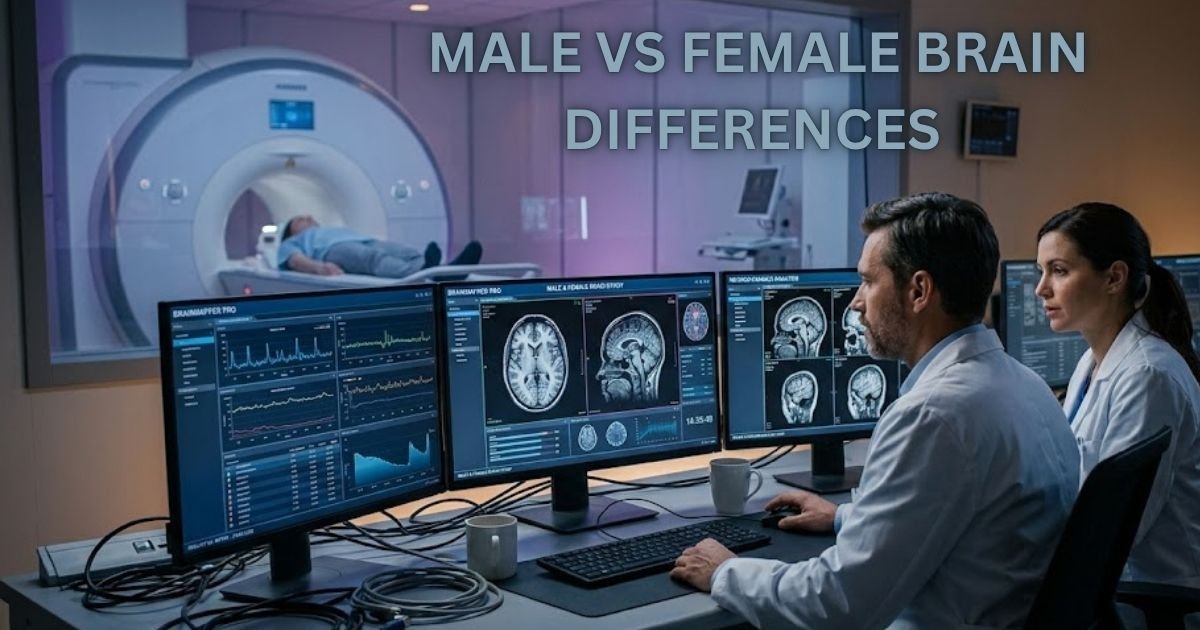
Male vs Female Brain Differences have long been a topic of scientific research and public interest. While studies have found some average differences in brain structure, connectivity, and hormone influences, there is significant overlap between individuals. Most cognitive abilities, intelligence, and personality traits are shaped by a combination of biology, environment, education, and life experiences. This guide explores what current research says, separates facts from myths, and explains how these findings apply in everyday life.
Structural Differences Architecture of Male vs. Female Brains
Brain Size and the Intelligence Question
Here’s the first surprise: male brains are about 10 percent larger than female brains (average male volume ≈ 1,345 cm³; female ≈ 1,222 cm³). This fact gets cited constantly—often with the implication that bigger means smarter.
Neuroscientists have known for decades that brain size correlates poorly with intelligence. What matters far more is neuron density, how efficiently regions communicate, and the quality of connections. Think of it like engine displacement versus fuel efficiency: a bigger engine doesn’t automatically outperform. Women’s brains achieve similar cognitive outcomes with different proportions of grey and white matter, suggesting efficiency matters more than size.
IQ tests bear this out: no significant gender gap appears in general intelligence. When differences do emerge in specific cognitive domains—and they sometimes do—size plays virtually no role. It’s the structure and wiring that count.
The Hippocampus: Memory and Gender
The hippocampus is a seahorse-shaped structure buried deep in the medial temporal lobe. Its job: convert fleeting experiences—a conversation with a friend, a first kiss, yesterday’s breakfast—into permanent memories.
Women’s hippocampi tend to be larger relative to their overall brain size. Research using diffusion tensor imaging (a type of brain scan measuring nerve fiber organization) has consistently found this pattern. The functional implication? Women often show superior performance on episodic memory tasks—recalling the specific details of personal experiences. They’re more likely to remember what someone wore, what was said, and how they felt.
But here’s the honest caveat: individual variation is enormous. Some men have large hippocampi and excellent autobiographical memory. Some women have smaller hippocampi and rely more on semantic memory (facts, concepts). Culture also shapes memory priorities—what a society values remembering, people tend to remember better.
The Amygdala: Emotion Processing
The amygdala is an almond-shaped cluster on both sides of the brain, famous for its role in emotion and fear responses. Neuroscientists have documented that male amygdalae tend to be slightly larger than female amygdalae—but here’s where it gets interesting: women show stronger activation of their amygdalae during emotional tasks.
The real difference isn’t size; it’s how the amygdala connects to other brain regions and which hemisphere leads the charge. In women, emotional memory processing is more active in the left amygdala; in men, the right amygdala dominates. This subtle neurological difference may underlie a striking behavioral pattern: women retain more vivid, emotionally rich memories than men. They recall emotional details faster and describe them as more intense—not because they’re more “emotional” in some vague sense, but because their brain’s architecture encodes emotion differently.
The health implication is significant. If the amygdala’s activity predicts vulnerability to depression, anxiety, and PTSD—conditions where emotional memory becomes entangled with distress—understanding these gender-specific encoding patterns could guide better treatment.
The Corpus Callosum: Communication Between Hemispheres
Imagine your brain as two separate countries. The corpus callosum is the bridge between them—a massive bundle of white matter (nerve fibers) connecting the left and right hemispheres so they can share information.
The corpus callosum is larger in women; it also shows denser connections. This means women’s hemispheres talk to each other more robustly. Research using functional MRI has shown that during cognitive tasks, women’s brains display more strongly coordinated activity between hemispheres, while men’s brains show tighter coordination within each hemisphere.
What does this mean behaviorally? The hypothesis (supported but not proven) is that greater interhemispheric integration supports tasks requiring the marriage of logic and intuition, language and emotion, context and detail. Conversely, men’s more compartmentalized approach may support intense focus on a single problem. Neither is “better”—they’re different problem-solving strategies.
Grey Matter vs. White Matter Distribution
Here’s a useful distinction: grey matter = information processing hubs (where neurons do the thinking); white matter = the connections (the cables linking those hubs).
Research consistently finds that men have proportionally more grey matter; women have proportionally more white matter. This maps onto their connectivity differences: men’s brains are optimized for local processing (diving deep into one region); women’s for global integration (connecting disparate regions). It’s not a hard rule—there’s substantial overlap—but the pattern holds up across studies.
What’s the behavioral echo? This difference may partially explain why, on average, men excel at tasks requiring sustained focus on a single domain (advanced mathematics, intensive coding, microsurgery), while women excel at tasks requiring cross-domain integration (project management integrating multiple constraints, clinical diagnosis weighing multiple symptoms, team leadership balancing competing needs).
Again: these are population averages. Your individual brain likely doesn’t fit the mold perfectly—and that’s normal.
Neurochemical & Hormonal Differences
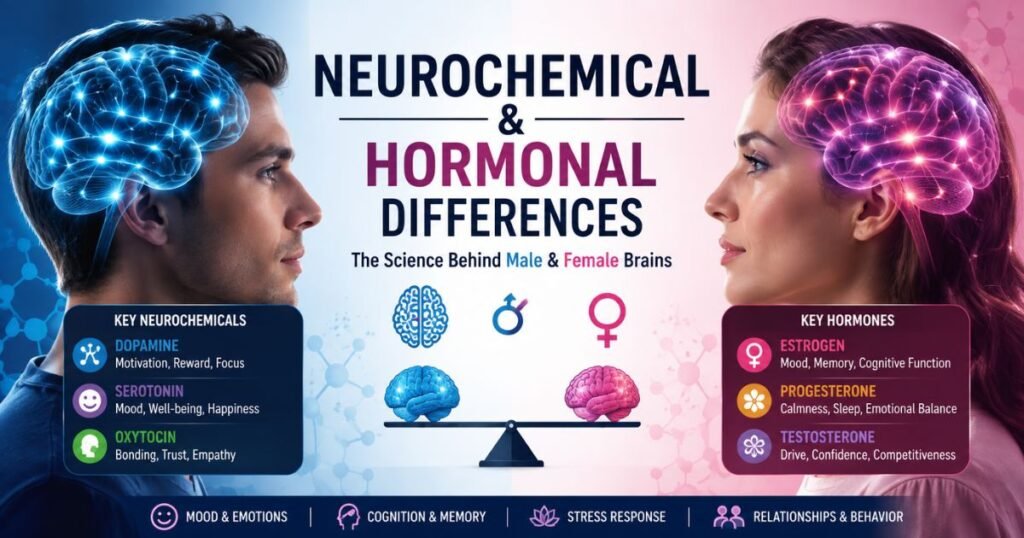
Structural differences alone don’t explain gender-linked behavioral patterns. The chemistry of the brain matters just as much.
Prenatal Testosterone: The Organizing Window
One of neuroscience’s most robust findings involves testosterone in the womb. Between weeks 8 and 24 of pregnancy, male fetuses experience a surge of testosterone that “organizes”—or permanently shapes—certain neural circuits. This isn’t subtle. MRI studies of human fetuses show that female brains develop with neurological connections (“functional connectivity”) that are nearly absent in male brains at the same stage.
Testosterone doesn’t create new brain regions. Instead, it prunes certain connections and strengthens others, sculpting circuits involved in spatial processing, motor control, and action-orientation. Female brains skip this testosterone surge and follow a developmental trajectory that, on average, maintains more widespread connectivity.
This early organizational window has lifelong effects. But here’s what matters: “organizing” isn’t the same as “determining.” Hormones set a foundation; experience, culture, and individual choice build on it.
Sex Hormone Receptors and Lifelong Influence
After birth, sex hormones continue to shape brain function. Many brain regions contain high concentrations of receptors for estrogen, progesterone, and testosterone—concentrated especially in the amygdala, hippocampus, hypothalamus, and prefrontal cortex.
These hormones don’t just affect reproduction. Estrogen influences serotonin production and cognition. Testosterone modulates aggression circuitry and reward processing. Progesterone affects anxiety responses. Over a lifetime, fluctuating levels—during puberty, monthly cycles, pregnancy, menopause, and andropause—create measurable shifts in brain function, mood, and cognitive performance.
For women, the menopause transition exemplifies this: declining estrogen correlates with changes in verbal fluency, memory encoding, and mood. For men, age-related testosterone decline produces measurable shifts in motivation and spatial ability. These aren’t imaginary; they’re documented in brain imaging studies. Understanding them normalizes them and opens doors to targeted interventions.
Neurotransmitter Processing
Men and women process the brain’s chemical messengers differently. Take serotonin, the neurotransmitter implicated in mood regulation, impulse control, and well-being. Women’s brains produce serotonin more slowly than men’s; they also have lower serotonin receptor density in key regions like the prefrontal cortex.
This neurochemical difference may partly explain why women experience depression and anxiety at roughly double the rate of men. It’s not weakness; it’s neurology. Understanding this biology destigmatizes these conditions and points to why certain treatments (like SSRIs, which boost serotonin availability) work.
Similarly, dopamine processing differs. This affects reward sensitivity, motivation, and addiction vulnerability—partly explaining why men have higher rates of alcoholism and substance dependence, while women show higher rates of behavioral addictions (food, shopping, social media).
X and Y Chromosomes Beyond Sex Determination
The Y chromosome is small—only about 27 protein-coding genes, compared to roughly 1,500 on the X chromosome. But those 27 genes matter. One (the SRY gene) triggers male development. Others influence brain function.
Meanwhile, women carry two X chromosomes. Through a process called X-inactivation, one X in each cell gets “turned off” randomly—creating a genetic mosaic where some cells express one X and neighboring cells express the other. Men have one X (and one Y), expressed uniformly.
The upshot: men and women have different sets of active X-linked genes throughout their brains. Research has linked several X-linked genes (like NLGN4X, involved in neural communication) to cognitive traits and conditions like autism spectrum disorder and dyslexia, showing sex-specific effects.
But again: individual genetic variation far exceeds the gender average. Knowing your sex tells you almost nothing about your individual genetic profile.
Functional Connectivity How Male and Female Brains “Wire” Differently
Structure is one thing. How those structures communicate is another.
Interhemispheric vs. Intrahemispheric Connectivity
A landmark 2014 University of Pennsylvania study scanned 949 young people (428 males, 521 females) using functional MRI. The finding: female brains showed more coordinated activity between hemispheres (interhemispheric); male brains showed tighter coordination within hemispheres (intrahemispheric).
This wasn’t a surprise—smaller studies hinted at it. But the sample size and consistency made it hard to dismiss.
What’s the functional implication? Interhemispheric connectivity supports integrative thinking: combining information from spatial centers (right hemisphere) with language centers (left hemisphere), or merging logical analysis with emotional context. Intrahemispheric connectivity supports focused depth: diving into a single problem domain and mastering it without distraction.
Both are valuable. Integration makes you good at switching between contexts, multitasking, and holistic thinking. Compartmentalization makes you good at sustained, intense focus. Most jobs need both; most people have some of each.
Brain Modularity and Task Engagement
Neuroscientists describe male brains as showing greater “modularity”—certain regions activate tightly together during a task, while others stay quiet. Female brains show more distributed activation—a given task engages more regions, even if some activation is weaker.
The behavioral correlate remains speculative, but it fits: men’s “tunnel vision” during focus; women’s contextual awareness during multitasking. Again, both are adaptive depending on the task. Surgery requires tunnel vision. Parenting requires contextual awareness of multiple simultaneous needs.
Behavioral and Cognitive Differences: Fact vs. Stereotype
Where do all these structural and neurochemical differences show up behaviorally? The evidence is mixed, overlapping, and often smaller than you’d expect.
Language and Verbal Ability
On average, women outperform men on most verbal tasks: reading comprehension, writing quality, vocabulary breadth, verbal fluency. The effect size is modest—much smaller than pop culture suggests—and training narrows it further. But the pattern is real and repeatable across cultures.
Why? The bilateral language organization in female brains (verbal centers on both sides) may provide redundancy and flexibility. Men’s left-hemisphere dominance for language may create efficiency but less flexibility. Combined with evidence that girls receive earlier language input and encouragement, the advantage emerges early and persists.
Spatial Reasoning and Visuospatial Skills
Flip the pattern: men outperform on average on mental rotation tasks (imagining a 3D object spinning), spatial navigation, and aiming accuracy. Again, the effect size is moderate; overlap is massive. With training, women match or exceed men.
The neurological basis likely involves the slightly different organization of spatial processing in male brains, possibly related to their greater right-hemisphere dominance and compartmentalized connectivity supporting sustained spatial focus.
Multitasking and Task-Switching
Women often outperform on laboratory multitasking tests. The explanation aligns with connectivity findings: greater interhemispheric integration may support rapid context-switching between disparate domains.
Honest caveat: In high-load scenarios (where both tasks demand full attention), both genders’ performance plummets and the gap shrinks or vanishes. Multitasking isn’t a superpower for anyone; it just reveals different default strategies.
Emotional Processing and Memory
Here’s where the amygdala and hippocampus differences shine through behaviorally. Women retain stronger, more vivid emotional memories. They recall emotional details faster, describe them as more intense, and retain them longer.
This isn’t “being more emotional” in a stereotypical sense. It’s a neurological encoding difference. Men aren’t unfeeling; their amygdalas just organize emotional information differently—more compartmentalized, possibly abstracted from the sensory details.
Health implication: This enhanced emotional encoding may increase female vulnerability to re-traumatization in PTSD and feed depressive rumination (replaying emotional events). But it also supports emotional intelligence and interpersonal sensitivity.
Cognitive Abilities That Show No Gender Difference
Let’s be clear about what doesn’t differ: General intelligence (IQ) shows no gender gap. Neither do mathematical ability (when cultural and educational barriers are removed), analytical reasoning, problem-solving, or creativity. These stereotypes crumble under scrutiny.
Why Brain Differences Exist: Evolutionary & Developmental Roots
The “why” remains partly mysterious, but a few threads emerge.
Evolutionary hypothesis: Different reproductive roles may have shaped certain circuits. Males’ parental investment in offspring was historically lower than females’, potentially favoring circuitry supporting territorial competition and rapid spatial/motor responses. Females’ higher parental investment may have favored circuits supporting emotional attunement, verbal communication, and integrative thinking for balancing multiple offspring needs.
Caveat: This is speculative. Evolution shaped tendencies, not destinies. Humans override evolutionary patterns constantly through culture, choice, and individual agency.
Developmental plasticity: The good news is your brain isn’t fixed. Neuroplasticity means you can train skills that don’t come naturally. A woman can develop exceptional spatial reasoning; a man can become highly emotionally intelligent. The brain reorganizes in response to experience throughout life.
Health Implications: Why Gender Matters for Mental & Neurological Health
Where brain differences do translate into real-world impact is health and disease risk. Men and women show starkly different rates of psychiatric and neurological conditions. Brain biology is one contributor—not the whole story, but a meaningful one.
| Condition | Gender Ratio / Pattern | Likely Brain Factor |
| Depression | Women 2x more likely | Weaker serotonin synthesis; enhanced amygdala reactivity; stronger emotional memory encoding intensifies rumination |
| Anxiety Disorders | Women 2x more likely | Faster threat detection in amygdala; stronger interhemispheric anxiety loop (emotion + cognition feeding each other) |
| Autism Spectrum Disorder | Boys 4x more commonly diagnosed | Atypical “extreme male” brain structure; girls’ greater verbal facility and social integration may mask traits |
| ADHD | Boys 3x more commonly diagnosed | Male brain compartmentalization may struggle with executive integration; female connectivity may support attention distribution |
| Dyslexia | Boys 2–3x higher rate | Atypical left-hemisphere language development; hypothesis: male brains slower to develop bilateral language backup |
| Schizophrenia | Men 1.4x more likely; earlier onset | Testosterone surge at puberty may destabilize certain circuits in genetically vulnerable males |
| Parkinson’s Disease | Men 1.5x more likely | Larger male cerebellum may increase dopamine system vulnerability; testosterone modulation of dopamine differs |
| Stroke | Men initially 1.3x; women catch up post-menopause | Hormonal factors; female brain connectivity may affect recovery patterns |
| PTSD | Women 2x more likely | Enhanced amygdala-hippocampus coupling = stronger trauma memory encoding; harder to “forget” emotionally |
Reading this table: These ratios describe population patterns, not individual destiny. Brain biology contributes—sometimes significantly—but environment, stress, healthcare access, and social support are equally or more important. Knowing these patterns enables earlier detection and tailored treatment.
Myth-Busting: What Brain Differences DON’T Mean
Let’s clear the air on persistent misconceptions:
Myth: “Women use only 10% of their brains; men use more.” Complete nonsense. Everyone uses nearly all of their brain, just in different patterns. This fiction originated in 1960s pop psychology and refuses to die.
Myth: “Men are logical; women are emotional.” Neuroscience doesn’t support this binary. Both genders process information logically and emotionally. The difference is in default strategy, not capability. Women default to integrating emotion into decisions; men default to compartmentalizing it. Neither approach is better—context determines effectiveness.
Myth: “Left brain = logic; right brain = creativity.” This oversimplification is outdated. Both hemispheres handle both functions. Creativity and logic are whole-brain endeavors.
Myth: “If your brain doesn’t match gender stereotypes, something’s wrong with you.” No. You’re normal. Most people show mixed cognitive profiles. Neuroscience describes population tendencies, not individual blueprints.
Myth: “Brain differences explain gender inequality in STEM, leadership, or income.” This one’s important: when cultural and educational barriers fall, participation equalizes. Brain biology is a small piece; systemic bias, opportunity access, and social expectations are the real drivers.
Practical Takeaway How to Apply Brain Differences to Your Life
Knowing these differences matters—not to reinforce stereotypes, but to build empathy and optimize your own choices.
For relationships: If your partner’s brain works differently from yours, that’s not a flaw—it’s wiring. If they struggle with multitasking while you thrive on context-switching, that’s not laziness; it’s connectivity. Talk about how you each actually process information and make decisions, not how you “should.”
For parenting: Don’t force kids into stereotype molds. Your son might excel at language; your daughter at spatial reasoning. Encourage both in everything. When a child struggles—your boy with reading, your girl with math anxiety—intervene early; these patterns are real, but trainable.
For your career: Recognize your own brain’s strengths. Are you naturally good at deep focus or distributed attention? Verbal or visual? Use that knowledge in choosing roles. A compartmentalized brain excels in intense individual-contributor roles (research, coding, design); an integrative brain excels in roles requiring context-switching (management, consulting, teaching). Neither is better; knowing yourself matters.
For your mind: Your brain is plastic. Skills don’t come naturally? You can train them. Neuroplasticity means you’re never locked into a pattern.
Conclusion
Male and female brains differ in measurable, documented ways: structure (larger female hippocampi, different corpus callosum organization), connectivity (women more interhemispheric, men more compartmentalized), and neurochemistry (different serotonin and dopamine processing). These differences shape average behavioral tendencies—women often excel at language and multitasking; men at spatial reasoning and focused attention.
FAQs
Are men’s brains really bigger than women’s?
Yes, on average about 10 percent larger. But brain size doesn’t predict intelligence or capability. Larger female brains show equivalent IQ to larger male brains, suggesting efficient organization matters more than total volume.
Why do women have larger hippocampi?
The exact reason is unknown. But the larger female hippocampus correlates with better performance on episodic memory tasks (recalling personal experiences). Genetics, prenatal hormones, and lifelong use all contribute to structural variation.
Do men and women actually use different sides of their brains?
Both use both hemispheres throughout daily life. But connectivity differs: women show more integration between hemispheres; men more specialization within each hemisphere. Both patterns are adaptive.
Why are more boys diagnosed with autism than girls?
Likely multiple factors: boys’ brains may show more “extreme male” traits that clinicians recognize; girls may camouflage social difficulties better due to greater verbal facility and social sensitivity; or diagnostic bias may favor identifying “male” presentations of autism.
Can brain imaging tell if a scan came from a man or woman?
Deep learning models can predict gender from whole-brain scans with about 93 percent accuracy. But individual overlap is enormous—many scans from women show “male” patterns and vice versa. Population patterns don’t predict individuals.
Do hormones really shape the brain?
Absolutely. Prenatal testosterone, puberty hormones, and adult-level estrogen/testosterone all influence brain structure and function. Menopause and andropause cause measurable changes in brain activity, mood, and cognition.
Why are women twice as likely to develop depression?
Multifactorial: possible reduced serotonin synthesis in female brains, stronger emotional memory encoding, higher rates of adverse life experiences (poverty, abuse, discrimination), and diagnostic bias (women more likely to seek help, get diagnosed). Biology is one piece; environment is huge.
Does knowing about brain differences help relationships?
Possibly. Understanding your partner’s different wiring (tunnel vision vs. multitasking, compartmentalized vs. integrated emotion) can reduce frustration and improve communication. But stereotyping based on gender still damages relationships.
Will my daughter be better at language because she’s female?
On average, girls outperform boys in language tasks—but individual variation is enormous. Don’t assume ability based on gender. Encourage all kids in all subjects; let them find their real strengths.
If my brain doesn’t match my gender stereotype, am I abnormal?
No. You’re normal. Most people show mixed cognitive profiles that don’t fit neatly into gender boxes. Neuroscience describes population tendencies, not rules for individuals.
